Back

Types of Membrane Proteins definitions

Control buttons has been changed to "navigation" mode.
1/14
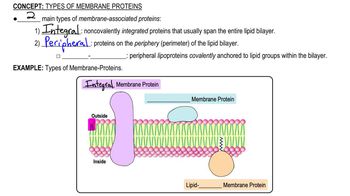
  • Integral Membrane Protein

    Non-covalently embedded within the phospholipid bilayer, extending across both extracellular and intracellular sides.
  • Peripheral Membrane Protein

    Located on the membrane's surface, not spanning the bilayer, often attached through non-covalent interactions.
  • Lipid-Linked Membrane Protein

    Anchored to the membrane by covalent bonds to lipid groups, remaining on the periphery without spanning the bilayer.
  • Lipoprotein

    A protein covalently attached to a lipid molecule, often serving as a subtype of peripheral membrane protein.
  • Phospholipid Bilayer

    Double-layered structure forming the fundamental architecture of biological membranes, providing a matrix for protein integration.
  • Extracellular Matrix

    Network outside the cell to which membrane proteins can anchor the cytoskeleton, aiding in structural support.
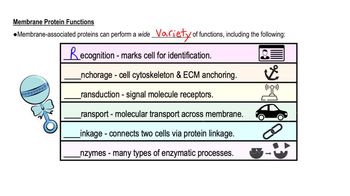
  • Recognition

    Function enabling immune cells to distinguish between healthy and foreign cells via specific membrane markers.
  • Anchorage

    Attachment of the cell's cytoskeleton to external structures, stabilizing cell position and shape.
  • Signal Transduction

    Transmission of signals across the membrane, allowing cells to communicate and respond to external cues.
  • Molecular Transport

    Movement of substances across the membrane, facilitating import and export of molecules essential for cell function.
  • Linkage

    Connection between adjacent cells through membrane proteins, promoting tissue integrity and communication.
  • Enzymatic Activity

    Catalysis of chemical reactions at the membrane, accelerating metabolic processes within the cell.
  • Membrane-Associated Protein

    Protein interacting with the cell membrane, either spanning or attached to its surface, performing diverse cellular roles.
  • RATTLE

    Mnemonic summarizing the main functions of membrane proteins: Recognition, Anchorage, Transduction, Transport, Linkage, Enzyme.