Skip to main content
Microbiology
My Course
Learn
Exam Prep
AI Tutor
Study Guides
Textbook Solutions
Flashcards
Explore
Try the app
My Course
Learn
Exam Prep
AI Tutor
Study Guides
Textbook Solutions
Flashcards
Explore
Try the app
Back
The Steps of PCR quiz
You can tap to flip the card.
What are the three main steps of each PCR cycle?
You can tap to flip the card.
👆
What are the three main steps of each PCR cycle?
The three main steps are denaturation, annealing, and extension.
Track progress
Control buttons has been changed to "navigation" mode.
1/15
Related flashcards
Related practice
Recommended videos
The Steps of PCR definitions
The Steps of PCR
15 Terms
The Steps of PCR
17. Biotechnology
4 problems
Topic
Brendan
Gel Electrophoresis
17. Biotechnology
3 problems
Topic
Nicole
17. Biotechnology
10 topics
14 problems
Chapter
Brendan
Guided course
03:33
1) Denaturation
4
views
Guided course
02:56
2) Annealing
3
views
Guided course
04:39
The Steps of PCR
4
views
Terms in this set (15)
Hide definitions
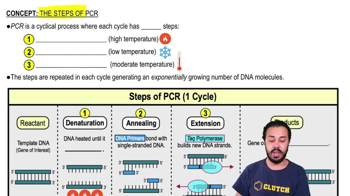
What are the three main steps of each PCR cycle?
The three main steps are denaturation, annealing, and extension.
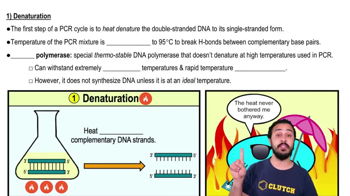
At what temperature does the denaturation step of PCR occur?
Denaturation occurs at about 95 degrees Celsius.
What happens to DNA during the denaturation step of PCR?
The double-stranded DNA is separated into single strands by breaking hydrogen bonds.
Why is Taq polymerase used in PCR?
Taq polymerase is thermostable and does not denature at the high temperatures used in PCR.
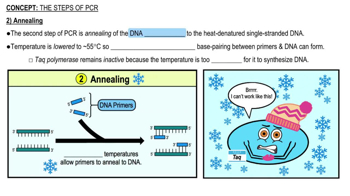
What is the purpose of the annealing step in PCR?
Annealing allows DNA primers to bind to the single-stranded DNA through complementary base pairing.
At what temperature does the annealing step of PCR occur?
Annealing occurs at about 55 degrees Celsius.
Is Taq polymerase active during the annealing step of PCR?
No, Taq polymerase remains inactive at the cooler temperature of the annealing step.
What happens during the extension step of PCR?
Taq polymerase extends the DNA primers by adding nucleotides to synthesize new DNA strands.
At what temperature does the extension step of PCR occur?
Extension occurs at about 72 degrees Celsius, which is optimal for Taq polymerase activity.
What direction does Taq polymerase extend the DNA primers during PCR?
Taq polymerase extends the primers in the 5' to 3' direction.
What is the result of one cycle of PCR?
One cycle produces two identical copies of the original DNA template.
How does PCR achieve exponential amplification of DNA?
Each cycle uses the products of the previous cycle as templates, doubling the DNA amount each time.
What components must be present in the PCR reaction mixture?
The mixture must contain template DNA, DNA primers, Taq polymerase, and DNA nucleotides.
What is the role of DNA primers in PCR?
DNA primers bind to the single-stranded DNA and provide a starting point for Taq polymerase to extend.
Why is it important that Taq polymerase is thermostable in PCR?
It must withstand the high temperatures of denaturation and remain functional for DNA synthesis.
 BackBack
 03:33
03:33