Skip to main content
Microbiology
My Course
Learn
Exam Prep
AI Tutor
Study Guides
Textbook Solutions
Flashcards
Explore
Try the app
My Course
Learn
Exam Prep
AI Tutor
Study Guides
Textbook Solutions
Flashcards
Explore
Try the app
Back
The Steps of PCR definitions
You can tap to flip the card.
PCR
You can tap to flip the card.
👆
PCR
A cyclical laboratory technique that exponentially amplifies specific DNA sequences through repeated thermal cycling.
Track progress
Control buttons has been changed to "navigation" mode.
1/15
Related flashcards
Related practice
Recommended videos
The Steps of PCR quiz
The Steps of PCR
15 Terms
The Steps of PCR
17. Biotechnology
4 problems
Topic
Brendan
Gel Electrophoresis
17. Biotechnology
3 problems
Topic
Nicole
17. Biotechnology
10 topics
14 problems
Chapter
Brendan
03:33
1) Denaturation
7
views
02:56
2) Annealing
7
views
04:39
The Steps of PCR
8
views
Terms in this set (15)
Hide definitions
PCR
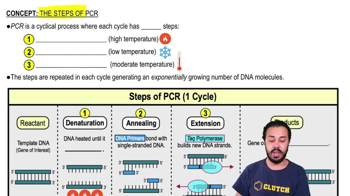
A cyclical laboratory technique that exponentially amplifies specific DNA sequences through repeated thermal cycling.
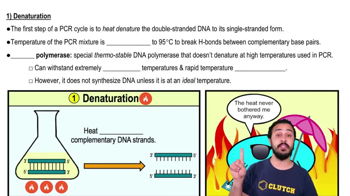
Denaturation
A high-temperature step, around 95°C, where hydrogen bonds break, separating double-stranded DNA into single strands.
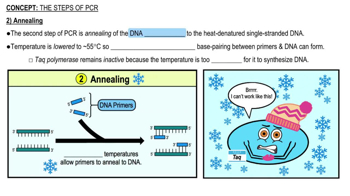
Annealing
A low-temperature phase, about 55°C, where primers bind to complementary sequences on single-stranded DNA.
Extension
A moderate-temperature step, near 72°C, where Taq polymerase synthesizes new DNA strands by adding nucleotides to primers.
Taq Polymerase
A thermostable enzyme from Thermus aquaticus that remains active at high temperatures and synthesizes DNA during PCR.
Primer
A short, single-stranded DNA sequence that binds to a specific target region, providing a starting point for DNA synthesis.
Template DNA
The original DNA strand containing the target sequence to be amplified during the PCR process.
Nucleotide
A molecular building block of DNA, consisting of a sugar, phosphate, and nitrogenous base, incorporated during extension.
Hydrogen Bond
A weak interaction between complementary DNA bases, disrupted during denaturation to separate DNA strands.
Thermal Cycling
The repeated process of heating and cooling in PCR to facilitate denaturation, annealing, and extension.
Complementary Base Pairing
The specific interaction between DNA bases, allowing primers to bind accurately to single-stranded DNA during annealing.
Exponential Amplification
The rapid increase in DNA quantity, where each PCR cycle doubles the number of target DNA molecules.
Test Tube
The vessel in which all PCR reactants, including DNA, primers, nucleotides, and polymerase, are combined and cycled.
Cycle
A single sequence of denaturation, annealing, and extension steps, repeated multiple times to amplify DNA.
Thermostability
The property of an enzyme, such as Taq polymerase, to remain functional at high temperatures required for PCR.
 BackBack
 03:33
03:33