Back

T Dependent & T Independent Antigens definitions

Control buttons has been changed to "navigation" mode.
1/15
  • T Dependent Antigen

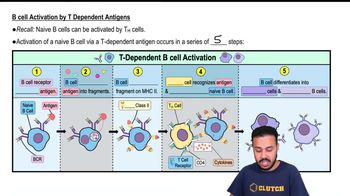
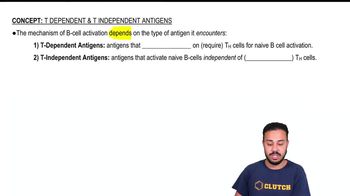
    Molecule requiring helper T cells for naive B cell activation, leading to antibody production and memory cell formation.
  • T Independent Antigen

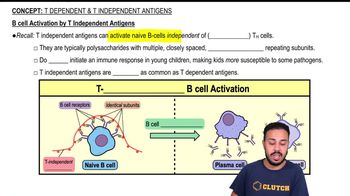
    Molecule, often a long polysaccharide, capable of activating naive B cells without helper T cell involvement.
  • Naive B Cell

    Immune cell that has not yet encountered its specific antigen and requires activation to function.
  • Helper T Cell

    Lymphocyte that assists in activating naive B cells by recognizing antigens presented on MHC Class II molecules.
  • B Cell Receptor

    Surface protein on B cells responsible for binding specific antigens, initiating the activation process.
  • MHC Class II Molecule

    Cell surface protein complex presenting processed antigen fragments to helper T cells for immune recognition.
  • Antigen Fragmentation

    Process where internalized antigens are broken into smaller pieces within B cells for presentation.
  • Cytokine

    Signaling molecule released by helper T cells that stimulates B cell activation and differentiation.
  • Plasma Cell

    Differentiated B cell specialized in secreting large amounts of antibodies during immune responses.
  • Memory B Cell

    Long-lived B cell formed after activation, providing rapid antibody response upon future antigen exposure.
  • Antibody

    Protein secreted by plasma cells that specifically binds antigens to neutralize or mark them for destruction.
  • Polysaccharide

    Long carbohydrate molecule with repeating subunits, often forming the structure of T independent antigens.
  • CD4 Molecule

    Surface protein on helper T cells that aids in recognizing antigens presented by MHC Class II molecules.
  • T Cell Receptor

    Surface molecule on helper T cells that detects antigen fragments displayed by MHC Class II complexes.
  • Pathogen

    Disease-causing organism, some of which possess T independent antigens, increasing risk in young children.