Skip to main content
Microbiology
My Course
Learn
Exam Prep
AI Tutor
Study Guides
Textbook Solutions
Flashcards
Explore
Try the app
My Course
Learn
Exam Prep
AI Tutor
Study Guides
Textbook Solutions
Flashcards
Explore
Try the app
Back
Reviewing the Different Types of Microscopes quiz
You can tap to flip the card.
What is the most common type of light microscope used in laboratories?
You can tap to flip the card.
👆
What is the most common type of light microscope used in laboratories?
The bright field microscope is the most common light microscope, often used to observe stained or unstained specimens.
Track progress
Control buttons has been changed to "navigation" mode.
1/15
Related flashcards
Related practice
Recommended videos
Reviewing the Different Types of Microscopes definitions
Reviewing the Different Types of Microscopes
14 Terms
Reviewing the Different Types of Microscopes
9. Microscopes
4 problems
Topic
Nicole
Introduction to Staining
9. Microscopes
Topic
9. Microscopes - Part 1 of 3
6 topics
12 problems
Chapter
Nicole
9. Microscopes - Part 2 of 3
8 topics
10 problems
Chapter
Nicole
9. Microscopes - Part 3 of 3
1 topic
3 problems
Chapter
05:32
Reviewing the Different Types of Microscopes
6
views
Terms in this set (15)
Hide definitions
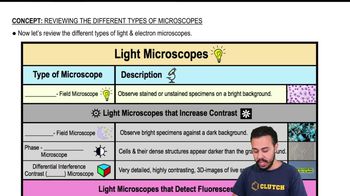
What is the most common type of light microscope used in laboratories?
The bright field microscope is the most common light microscope, often used to observe stained or unstained specimens.
How does a dark field microscope improve specimen visibility compared to a bright field microscope?
A dark field microscope creates a dark background, making the specimens appear brighter and increasing contrast.
What is the main advantage of a phase contrast microscope?
A phase contrast microscope enhances the visibility of dense structures in cells by making them appear darker against a grayish background.
Which light microscope produces detailed three-dimensional images of live specimens?
The differential interference contrast (DIC) microscope produces detailed 3D images of live specimens.
What unique feature does the confocal scanning laser microscope (CSLM) offer?
The CSLM allows for high contrast and 3D imaging with multiple planes of focus within the specimen.
Which microscope is best for imaging deep structures and creating time-lapse images?
The two-photon microscope provides high contrast, 3D imaging of deep structures, and is useful for time-lapse imaging.
What is the resolution capability of a super resolution microscope?
A super resolution microscope offers extremely high resolution, about 0.01 micrometers.
What is the main difference between light microscopes and electron microscopes?
Light microscopes use visible light to magnify specimens, while electron microscopes use electrons.
Which electron microscope is used to visualize internal cell structures?
The transmission electron microscope (TEM) is used to create 2D images of internal cell structures.
How does the scanning electron microscope (SEM) differ from the TEM in imaging?
The SEM generates 3D images of external cell structures by detecting electrons scattered from the specimen's surface.
Why might a bright field microscope be less effective for viewing transparent, unstained cells?
Transparent, unstained cells can create poor contrast in a bright field microscope, making them difficult to visualize.
What type of microscope is the compound light microscope?
The compound light microscope is a type of bright field microscope.
Which microscope is described as having 'HDTV-like' resolution among light microscopes?
The super resolution microscope is described as having HDTV-like, extremely high resolution.
What is the primary use of the scanning electron microscope (SEM)?
The SEM is mainly used to visualize external cell structures on the surface of specimens.
What is the abbreviation for the transmission electron microscope?
The abbreviation for the transmission electron microscope is TEM.
 BackBack
 05:32
05:32