Skip to main content
Microbiology
My Course
Learn
Exam Prep
AI Tutor
Study Guides
Textbook Solutions
Flashcards
Explore
Try the app
My Course
Learn
Exam Prep
AI Tutor
Study Guides
Textbook Solutions
Flashcards
Explore
Try the app
Back
Reviewing the 4 Types of Hypersensitivities quiz
You can tap to flip the card.
What does the 'A' in the ACID mnemonic for hypersensitivities stand for?
You can tap to flip the card.
👆
What does the 'A' in the ACID mnemonic for hypersensitivities stand for?
The 'A' stands for Allergic reaction, which refers to Type I hypersensitivity.
Track progress
Control buttons has been changed to "navigation" mode.
1/15
Related flashcards
Related practice
Recommended videos
Reviewing the 4 Types of Hypersensitivities definitions
Reviewing the 4 Types of Hypersensitivities
15 Terms
Reviewing the 4 Types of Hypersensitivities
27. Immunological Disorders
4 problems
Topic
Autoimmune Diseases
27. Immunological Disorders
3 problems
Topic
27. Immunological Disorders - Part 1 of 2
4 topics
11 problems
Chapter
27. Immunological Disorders - Part 2 of 2
4 topics
6 problems
Chapter
Guided course
06:03
Reviewing the 4 Types of Hypersensitivities
1
views
Guided course
02:15
Reviewing the 4 Types of Hypersensitivities Example 1
1
views
Terms in this set (15)
Hide definitions
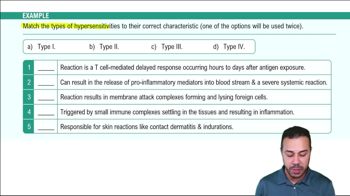
What does the 'A' in the ACID mnemonic for hypersensitivities stand for?
The 'A' stands for Allergic reaction, which refers to Type I hypersensitivity.
Which antibody is responsible for mediating Type I hypersensitivity reactions?
IgE antibodies mediate Type I hypersensitivity reactions.
What is the typical time frame for a Type I hypersensitivity reaction to occur after exposure to an allergen?
Type I hypersensitivity reactions occur immediately, usually within about 30 minutes.
What are common examples of Type I hypersensitivity reactions?
Examples include allergic reactions to dust, pollen, animal dander, hay fever, and food allergies.
What is the main immune reactant in Type II hypersensitivity reactions?
IgG and/or IgM antibodies are the main immune reactants in Type II hypersensitivity.
What type of antigens are targeted in Type II hypersensitivity reactions?
Type II hypersensitivity targets cell-bound antigens or antigens in the extracellular matrix.
Name two clinical examples of Type II hypersensitivity reactions.
Hemolytic transfusion reactions and hemolytic disease of the newborn are examples.
What is the main difference in immune reactants between Type III and Type IV hypersensitivity?
Type III is mediated by IgG/IgM antibodies, while Type IV is mediated by T cells, not antibodies.
What is the typical time frame for Type IV hypersensitivity reactions to develop?
Type IV reactions are delayed, usually occurring 24 to 72 hours after antigen exposure.
What is a classic example of a Type IV hypersensitivity reaction?
Contact dermatitis, such as the rash from poison ivy, is a classic example.
How do immune complexes contribute to tissue damage in Type III hypersensitivity?
Small immune complexes deposit in tissues, activate complement, and cause inflammation and tissue damage.
What is the main mechanism of tissue damage in Type IV hypersensitivity?
Sensitized T cells recognize antigen and promote inflammation, leading to tissue damage.
Which hypersensitivity type is most commonly associated with systemic anaphylaxis?
Type I hypersensitivity is most commonly associated with systemic anaphylaxis.
What is the role of mast cells and basophils in Type I hypersensitivity?
IgE antibodies bind to mast cells and basophils, and allergen binding triggers degranulation and release of inflammatory mediators.
Which hypersensitivity type is involved in transplant rejection and the tuberculin skin test?
Type IV (delayed T cell-mediated) hypersensitivity is involved in both transplant rejection and the tuberculin skin test.
 BackBack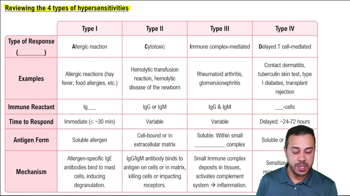
 06:03
06:03