Skip to main content
Microbiology
My Course
Learn
Exam Prep
AI Tutor
Study Guides
Textbook Solutions
Flashcards
Explore
Try the app
My Course
Learn
Exam Prep
AI Tutor
Study Guides
Textbook Solutions
Flashcards
Explore
Try the app
Back
Reviewing the 4 Types of Hypersensitivities definitions
You can tap to flip the card.
Hypersensitivity
You can tap to flip the card.
👆
Hypersensitivity
An exaggerated or inappropriate immune response causing tissue damage, classified into four distinct types based on mechanism and timing.
Track progress
Control buttons has been changed to "navigation" mode.
1/15
Related flashcards
Related practice
Recommended videos
Reviewing the 4 Types of Hypersensitivities quiz
Reviewing the 4 Types of Hypersensitivities
15 Terms
Reviewing the 4 Types of Hypersensitivities
27. Immunological Disorders
4 problems
Topic
Autoimmune Diseases
27. Immunological Disorders
3 problems
Topic
27. Immunological Disorders - Part 1 of 2
4 topics
11 problems
Chapter
27. Immunological Disorders - Part 2 of 2
4 topics
6 problems
Chapter
Guided course
06:03
Reviewing the 4 Types of Hypersensitivities
1
views
Guided course
02:15
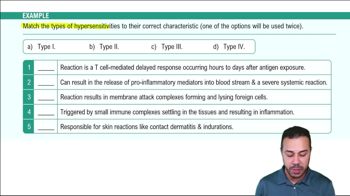
Reviewing the 4 Types of Hypersensitivities Example 1
1
views
Terms in this set (15)
Hide definitions
Hypersensitivity
An exaggerated or inappropriate immune response causing tissue damage, classified into four distinct types based on mechanism and timing.
IgE
An antibody class responsible for immediate allergic reactions by binding to mast cells and basophils, triggering mediator release.
Mast Cell
A cell type that releases pro-inflammatory mediators like histamine upon activation by IgE-allergen complexes, leading to allergic symptoms.
Basophil
A circulating white blood cell that, like mast cells, releases inflammatory mediators during allergic responses upon IgE activation.
Histamine
A chemical mediator released from mast cells and basophils, causing symptoms such as swelling, redness, and itching in allergic reactions.
Anaphylaxis
A severe, systemic allergic reaction that can be life-threatening, characterized by rapid onset and widespread mediator release.
IgG
A major antibody class involved in cytotoxic and immune complex hypersensitivities, targeting cell-bound or soluble antigens.
IgM
An antibody class that participates in cytotoxic and immune complex hypersensitivities, often acting early in immune responses.
Antigen
A molecule recognized by the immune system, which can be soluble or cell-bound, triggering hypersensitivity reactions.
Immune Complex
A structure formed when antibodies bind to soluble antigens, which can deposit in tissues and cause inflammation and damage.
Complement System
A group of proteins activated by immune complexes, leading to inflammation and tissue injury in certain hypersensitivity reactions.
T Cell
A lymphocyte mediating delayed hypersensitivity by recognizing antigens and promoting inflammation without antibody involvement.
Contact Dermatitis
A skin inflammation resulting from T cell-mediated hypersensitivity, often triggered by substances like poison ivy or latex.
Hemolytic Transfusion Reaction
A cytotoxic response where antibodies attack transfused red blood cells due to blood type incompatibility, causing cell destruction.
Rheumatoid Arthritis
A chronic inflammatory disorder where immune complexes deposit in joints, leading to persistent inflammation and tissue damage.
 BackBack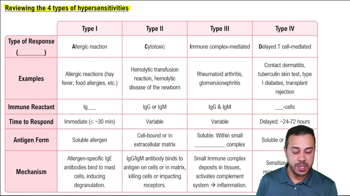
 06:03
06:03