Back

Review of Prokaryotic Surface Structures quiz

Control buttons has been changed to "navigation" mode.
1/15
  • What is the glycocalyx and what are its two forms?

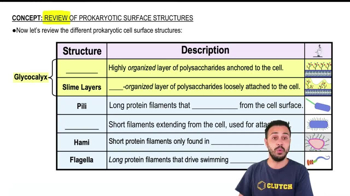
    The glycocalyx is a sticky, gel-like polysaccharide layer surrounding prokaryotic cells. Its two forms are the capsule (organized, tightly anchored) and the slime layer (less organized, loosely attached).
  • How does a capsule differ from a slime layer in prokaryotes?

    A capsule is a highly organized, tightly anchored layer of polysaccharides, while a slime layer is less organized and more loosely attached to the cell.
  • What are pili and what are their main functions?

    Pili are long protein filaments extending from the cell surface, used for motility (twitching and gliding) and as sex pili for DNA transfer during conjugation.
  • What is the primary role of fimbriae in prokaryotic cells?

    Fimbriae are short filaments mainly used for attachment to surfaces and other cells, playing a key role in biofilm formation.
  • What are hammy and in which organisms are they found?

    Hammy are short protein filaments found only in archaea, acting as grappling hooks for adhesion to surfaces and other cells.
  • What is the main function of flagella in prokaryotes?

    Flagella are long protein filaments essential for swimming motility, enabling cells to move using a run and tumble mechanism.
  • Which surface structure is involved in twitching motility and how does it work?

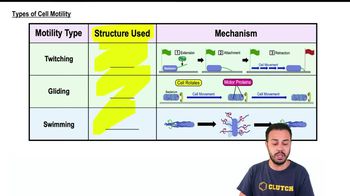
    Pili are involved in twitching motility by extending, attaching to a surface, and retracting to drag the cell forward in a jerking motion.
  • What is gliding motility and which structure is responsible for it?

    Gliding motility is a smooth movement of cells using pili, though the exact mechanism is less understood and involves motor proteins.
  • How does swimming motility differ from twitching and gliding motility?

    Swimming motility uses flagella for movement, while twitching and gliding motility use pili.
  • Describe the run and tumble mechanism of swimming motility.

    During swimming motility, flagella rotate counterclockwise for smooth runs and clockwise for tumbles, which change the cell's direction.
  • What is the role of the sex pilus in bacterial cells?

    The sex pilus facilitates conjugation, allowing direct transfer of DNA between bacterial cells.
  • Why are fimbriae important for biofilm formation?

    Fimbriae enable cells to attach to each other and surfaces, which is essential for forming biofilms—communities of microbes in an extracellular matrix.
  • What distinguishes the capsule from the slime layer in terms of attachment to the cell?

    The capsule is tightly anchored to the cell, while the slime layer is more loosely attached.
  • Which prokaryotic surface structure is unique to archaea and what is its function?

    Hammy are unique to archaea and function as grappling hooks for adhesion.
  • How do tumbles contribute to swimming motility in prokaryotes?

    Tumbles, caused by clockwise rotation of flagella, allow the cell to change direction during swimming motility.