Back

Review of Chemicals Used to Control Microbial Growth quiz

Control buttons has been changed to "navigation" mode.
1/15
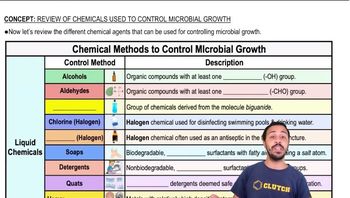
  • What are the two main categories of chemical methods used to control microbial growth?

    The two main categories are liquid chemical methods and gaseous chemical methods.
  • What functional group is present in all alcohols used for microbial control?

    Alcohols contain at least one hydroxyl group (–OH) functional group.
  • What is the functional group found in aldehydes?

    Aldehydes contain a CHO functional group.
  • What are biguanides derived from?

    Biguanides are a class of chemicals derived from the molecule called biguanide.
  • Which two halogens are commonly used to control microbial growth?

    Chlorine and iodine are the two halogens commonly used.
  • How is chlorine typically used in microbial control?

    Chlorine is used to disinfect swimming pools and drinking water, depending on its concentration and form.
  • In what forms is iodine commonly used as an antiseptic?

    Iodine is often used as a tincture or in an iota form.
  • What is the main difference between soaps and detergents as surfactants?

    Soaps are biodegradable natural surfactants that can form soap scum in hard water, while detergents are synthetic, non-biodegradable, and do not form soap scum.
  • What are quats and what is their significance in microbial control?

    Quats are cationic (positively charged) detergents with antimicrobial properties, safe for use in food preparation.
  • How do soaps control microbial growth?

    Soaps act as degermers by removing microbes from surfaces but do not kill them.
  • Which heavy metals are mentioned as being used to control microbial growth?

    Copper and silver are the heavy metals mentioned.
  • What are phenolics and who originally used them as surgical sterilizers?

    Phenolics are chemicals derived from phenol, which was originally used as a surgical sterilizer by John Lister.
  • What are peroxygens and how do they function in microbial control?

    Peroxygens, such as paracetic acid and hydrogen peroxide, are strong oxidizing agents that can sterilize objects by causing oxidation.
  • What is ethylene oxide and what are its risks?

    Ethylene oxide is a highly flammable and potentially explosive gas sterilizer that requires controlled treatment in a special chamber.
  • What is ozone and how does it control microbial growth?

    Ozone is an unstable form of oxygen (O3) and a strong oxidizing agent that can cause cell lysis to control microbial growth.