Back

Review of Chemicals Used to Control Microbial Growth definitions

Control buttons has been changed to "navigation" mode.
1/15
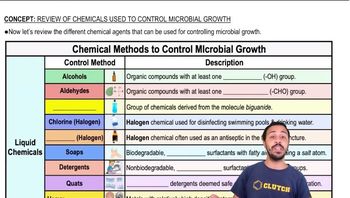
  • Alcohols

    Organic compounds with at least one hydroxyl group, commonly used as liquid agents to control microbes.
  • Aldehydes

    Organic compounds containing a CHO functional group, effective in microbial control.
  • Biguanides

    Chemicals derived from biguanide molecules, used as liquid agents for microbial control.
  • Halogens

    Group including chlorine and iodine, used for disinfecting water and as antiseptics.
  • Chlorine

    Halogen chemical used to disinfect swimming pools and drinking water, effectiveness varies by form and concentration.
  • Iodine

    Halogen often used as an antiseptic, available in tincture or iota forms.
  • Surfactants

    Surface-active agents like soaps, detergents, and quats, aiding in microbial removal or destruction.
  • Soaps

    Biodegradable natural surfactants that remove microbes from surfaces but do not kill them.
  • Detergents

    Synthetic surfactants that do not form scum in hard water and can include antimicrobial types.
  • Quats

    Cationic detergents with antimicrobial properties, safe for food preparation and disrupt microbial membranes.
  • Heavy Metals

    Elements like copper and silver with high densities, used for microbial control.
  • Phenolics

    Chemicals derived from phenol, historically used as surgical sterilizers.
  • Peroxygens

    Strong oxidizing agents such as paracetic acid and hydrogen peroxide, used for sterilization at low concentrations.
  • Ethylene Oxide

    Highly flammable gaseous sterilizer requiring controlled chamber treatment.
  • Ozone

    Unstable oxygen form (O3), strong oxidizer causing cell lysis for microbial control.