Back

Review of Aerobic Cellular Respiration quiz

Control buttons has been changed to "navigation" mode.
1/15
  • What are the four stages of aerobic cellular respiration, in order?

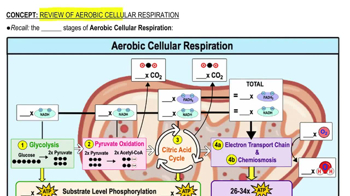
    The four stages are glycolysis, pyruvate oxidation, Krebs cycle (citric acid cycle), and oxidative phosphorylation.
  • Where does glycolysis occur within the cell?

    Glycolysis occurs in the cytoplasm of the cell, outside the mitochondria.
  • What is the starting molecule for glycolysis and what are its main products?

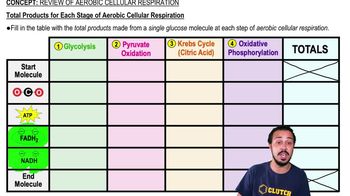
    The starting molecule is glucose, and its main products are 2 pyruvate, 2 NADH, and a net of 2 ATP.
  • How many carbon dioxide molecules are produced during glycolysis?

    Zero carbon dioxide molecules are produced during glycolysis.
  • What happens to pyruvate after glycolysis?

    Pyruvate is transported into the mitochondrial matrix, where it undergoes pyruvate oxidation to form acetyl CoA, NADH, and CO2.
  • How many NADH and CO2 molecules are produced during pyruvate oxidation from one glucose?

    Pyruvate oxidation produces 2 NADH and 2 CO2 molecules per glucose.
  • What is the starting molecule for the Krebs cycle and what are its main products?

    The starting molecule is 2 acetyl CoA, and the main products are 2 ATP, 6 NADH, 2 FADH2, and 4 CO2.
  • How many total carbon dioxide molecules are released from one glucose during aerobic respiration?

    A total of 6 carbon dioxide molecules are released from one glucose molecule.
  • What is the main purpose of NADH and FADH2 produced in earlier stages?

    NADH and FADH2 carry electrons to the electron transport chain for ATP production during oxidative phosphorylation.
  • Where does oxidative phosphorylation occur and what are its main products?

    Oxidative phosphorylation occurs in the mitochondria and mainly produces 26-34 ATP and water.
  • What acts as the final electron acceptor in the electron transport chain?

    Oxygen gas (O2) acts as the final electron acceptor, forming water.
  • How many ATP molecules are produced by substrate-level phosphorylation in glycolysis and the Krebs cycle combined?

    A total of 4 ATP molecules are produced by substrate-level phosphorylation (2 from glycolysis and 2 from the Krebs cycle).
  • What is the total ATP yield from one glucose molecule in aerobic cellular respiration?

    The total ATP yield is between 30 and 38 ATP molecules per glucose.
  • What is the ending molecule of the Krebs cycle, and why is it significant?

    The ending molecule is oxaloacetate, which is regenerated to continue the cycle.
  • How many total NADH and FADH2 molecules are produced from one glucose during aerobic respiration?

    A total of 10 NADH and 2 FADH2 molecules are produced from one glucose.