Back

Review of Aerobic Cellular Respiration definitions

Control buttons has been changed to "navigation" mode.
1/15
  • Glycolysis

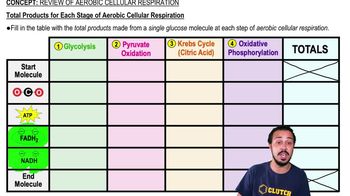
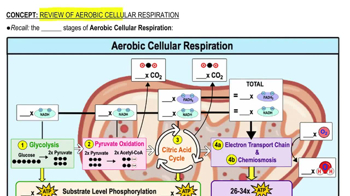
    Initial stage in the cytoplasm where glucose splits into two pyruvate molecules, yielding 2 ATP and 2 NADH without CO2 release.
  • Pyruvate Oxidation

    Conversion of pyruvate to acetyl CoA in the mitochondrial matrix, producing NADH and CO2 but no ATP.
  • Krebs Cycle

    Cyclic process in the mitochondrial matrix that generates ATP, NADH, FADH2, and releases CO2 from acetyl CoA.
  • Oxidative Phosphorylation

    Final stage producing most ATP, driven by the electron transport chain and chemiosmosis, ending with water formation.
  • Electron Transport Chain

    Series of mitochondrial membrane proteins transferring electrons from NADH and FADH2, creating a proton gradient.
  • Chemiosmosis

    Process where the proton gradient powers ATP synthesis as protons flow through ATP synthase.
  • ATP

    Primary energy currency produced in varying amounts at each stage, with the majority formed during oxidative phosphorylation.
  • NADH

    Electron carrier generated in multiple stages, delivering high-energy electrons to the electron transport chain.
  • FADH2

    Electron carrier produced mainly in the Krebs cycle, contributing electrons to the electron transport chain.
  • Acetyl CoA

    Two-carbon molecule entering the Krebs cycle, formed from pyruvate and essential for further energy extraction.
  • Mitochondrial Matrix

    Innermost compartment of mitochondria where pyruvate oxidation and the Krebs cycle occur.
  • Cytoplasm

    Cellular region outside mitochondria where glycolysis takes place.
  • Substrate Level Phosphorylation

    Direct formation of ATP in glycolysis and the Krebs cycle, independent of the electron transport chain.
  • Carbon Dioxide

    Waste product released during pyruvate oxidation and the Krebs cycle, originating from glucose carbons.
  • Oxygen

    Final electron acceptor in the electron transport chain, combining with protons to form water.