Back

Reservoirs of Infection quiz

Control buttons has been changed to "navigation" mode.
1/15
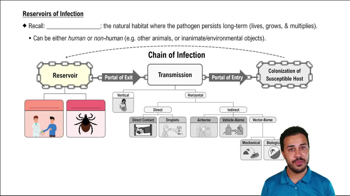
  • What is a reservoir of infection?

    A reservoir of infection is the natural habitat where a pathogen persists, living, growing, and multiplying long term.
  • What are the two main categories of reservoirs of infection?

    The two main categories are human reservoirs and nonhuman reservoirs.
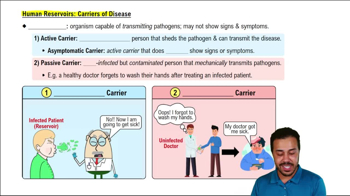
  • What is an active carrier in the context of human reservoirs?

    An active carrier is an infected person who sheds the pathogen and can transmit the disease to others, with or without showing symptoms.
  • How does an asymptomatic carrier differ from other active carriers?

    An asymptomatic carrier is an active carrier who sheds the pathogen but does not show any signs or symptoms of the disease.
  • Why are asymptomatic carriers problematic in disease control?

    They are problematic because they can unknowingly transmit pathogens to others while not showing any symptoms themselves.
  • What is a passive carrier?

    A passive carrier is an uninfected person who is contaminated with a pathogen and can mechanically transmit it to others without being infected themselves.
  • Give an example of a passive carrier scenario.

    A healthy doctor who forgets to wash their hands after treating an infected patient and then transmits the pathogen to another person is a passive carrier.
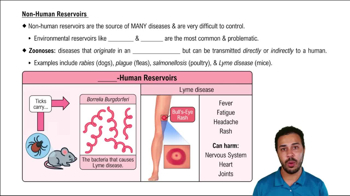
  • What are nonhuman reservoirs?

    Nonhuman reservoirs are any nonhuman sources, such as animals, plants, objects, or environmental parts, that support the long-term growth and multiplication of a pathogen.
  • Why are nonhuman reservoirs often difficult to control?

    They are difficult to control because they include a wide range of sources like animals and the environment, which are not easily managed.
  • What is a zoonosis?

    A zoonosis is a disease that primarily exists in animals but can be transmitted to humans, either directly or indirectly.
  • How can zoonotic diseases be transmitted to humans?

    They can be transmitted directly, such as through an animal bite, or indirectly, such as through contaminated food or water.
  • Name two examples of zoonotic diseases and their animal reservoirs.

    Rabies with dogs and Lyme disease with mice (transmitted by ticks) are examples of zoonotic diseases and their animal reservoirs.
  • What bacterium causes Lyme disease, and how is it transmitted?

    Lyme disease is caused by Borrelia burgdorferi, which is transmitted to humans by tick bites.
  • What are common environmental reservoirs?

    Soil and water are common and problematic environmental reservoirs for pathogens.
  • Why is understanding reservoirs of infection important in epidemiology?

    Understanding reservoirs is crucial for controlling infectious diseases and preventing their spread.