Back

Reservoirs of Infection definitions

Control buttons has been changed to "navigation" mode.
1/15
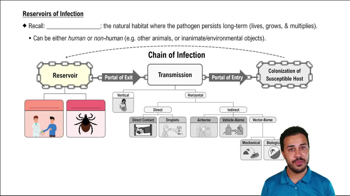
  • Reservoir

    Natural habitat where a pathogen persists, allowing it to live, grow, and multiply over time.
  • Pathogen

    Microorganism capable of causing disease, often persisting in specific habitats before infecting hosts.
  • Human Reservoir

    Person or group in which a pathogen lives and multiplies, serving as a source of infection for others.
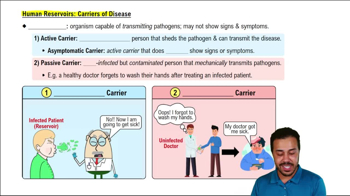
  • Active Carrier

    Infected individual who sheds pathogens, potentially with or without showing any signs or symptoms.
  • Asymptomatic Carrier

    Infected person who transmits pathogens to others while showing no signs or symptoms themselves.
  • Passive Carrier

    Uninfected individual who mechanically transfers pathogens, often via contaminated hands or clothing.
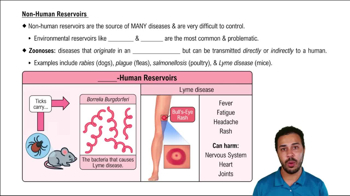
  • Nonhuman Reservoir

    Animal, plant, or environmental source that supports long-term survival and multiplication of pathogens.
  • Environmental Reservoir

    Nonliving habitat such as soil or water where pathogens can persist and serve as sources of infection.
  • Zoonosis

    Disease primarily existing in animals but capable of being transmitted to humans, directly or indirectly.
  • Lyme Disease

    Tick-borne infection caused by Borrelia burgdorferi, often presenting with a bullseye rash and multisystem effects.
  • Borrelia burgdorferi

    Spirochete bacterium with a corkscrew shape, responsible for causing Lyme disease in humans.
  • Spirochete

    Bacterium characterized by a spiral or corkscrew shape, aiding in movement through viscous environments.
  • Carrier

    Organism capable of transmitting pathogens to others, with or without displaying disease symptoms.
  • Transmission

    Process by which pathogens move from a reservoir or carrier to a susceptible host, initiating infection.
  • Zoonotic Disease

    Infection originating in animals that can be transferred to humans, often involving complex transmission cycles.