Back

Proton Motive Force Drives Flagellar Motility quiz

Control buttons has been changed to "navigation" mode.
1/15
  • What does PMF stand for in microbiology?

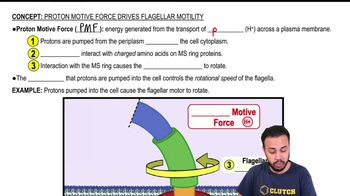
    PMF stands for Proton Motive Force, which is the energy generated from the transport of protons (H+) across the plasma membrane.
  • What ions are transported across the plasma membrane to generate PMF?

    Protons, or hydrogen ions (H+), are transported across the plasma membrane to generate PMF.
  • How many steps are involved in generating the proton motive force?

    There are three steps involved in generating the proton motive force.
  • From which cellular compartment are protons pumped during the first step of PMF generation?

    Protons are pumped from the periplasm into the cell's cytoplasm during the first step.
  • What is the periplasm in a gram-negative cell?

    The periplasm is the region between the peptidoglycan layer and the plasma membrane in a gram-negative cell.
  • What structure is characteristic of gram-negative cells as shown in the flagellum diagram?

    Gram-negative cells have an outer membrane, which is shown in the flagellum diagram.
  • With what protein do protons interact after entering the cytoplasm?

    Protons interact with charged amino acids on the MS ring protein after entering the cytoplasm.
  • What type of interaction occurs between protons and the MS ring protein?

    An electrostatic interaction occurs between protons and the MS ring protein.
  • What effect does the interaction between protons and the MS ring have on the flagellum?

    The interaction causes the flagellum to rotate, enabling cell motility.
  • What are the two types of movement resulting from flagellar rotation?

    The two types of movement are 'run' and 'tumble.'
  • What controls the rotational speed of the flagella?

    The speed at which protons are pumped into the cell controls the rotational speed of the flagella.
  • What is the main function of the energy generated by PMF in prokaryotes?

    The energy from PMF is used to propel the cell towards more favorable environments.
  • What is the process called when cells move toward favorable environments?

    This process is called chemotaxis.
  • Why are protons able to interact with amino acids on the MS ring?

    Protons are positively charged and can interact electrostatically with charged amino acids.
  • What will be discussed in the next lesson related to PMF and motility?

    The next lesson will discuss chemotaxis, the movement of cells toward favorable environments.