Back

Proton Motive Force Drives Flagellar Motility definitions

Control buttons has been changed to "navigation" mode.
1/15
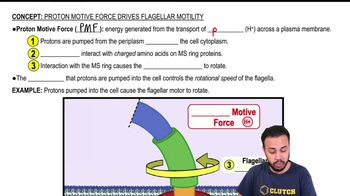
  • Proton Motive Force

    Energy generated by the movement of hydrogen ions across the plasma membrane, powering cellular processes.
  • Flagellar Motility

    Cell movement enabled by the rotation of a whip-like structure, allowing navigation in liquid environments.
  • Plasma Membrane

    Selective barrier surrounding the cell, crucial for maintaining ion gradients and energy generation.
  • Gram-Negative Cell

    Bacterial type characterized by an outer membrane and a thin peptidoglycan layer, influencing structure and function.
  • Periplasm

    Space between the outer membrane and plasma membrane in certain bacteria, containing various enzymes and ions.
  • Cytoplasm

    Internal fluid of the cell where metabolic reactions and energy conversion occur.
  • MS Ring

    Protein structure within the flagellar basal body, essential for converting ion flow into rotational motion.
  • Amino Acids

    Charged molecules within proteins that interact electrostatically with ions, influencing protein function.
  • Electrostatic Interaction

    Attraction or repulsion between charged particles, critical for energy conversion in cellular structures.
  • Flagellum

    Long, helical appendage protruding from the cell, responsible for propulsion and movement.
  • Run

    Straight, directed movement phase of a motile cell, resulting from coordinated flagellar rotation.
  • Tumble

    Random reorientation phase of a motile cell, caused by changes in flagellar rotation.
  • Chemotaxis

    Directed movement of a cell toward or away from chemical stimuli, enhancing survival in changing environments.
  • Peptidoglycan Layer

    Structural component of bacterial cell walls, providing rigidity and shape, located beneath the outer membrane.
  • Hydrogen Ions

    Positively charged particles (H+) whose movement across membranes generates energy for cellular functions.