Skip to main content
Microbiology
My Course
Learn
Exam Prep
AI Tutor
Study Guides
Textbook Solutions
Flashcards
Explore
Try the app
My Course
Learn
Exam Prep
AI Tutor
Study Guides
Textbook Solutions
Flashcards
Explore
Try the app
Back
Properties of Water- Thermal quiz
You can tap to flip the card.
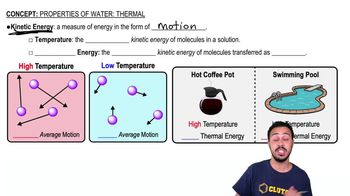
What is kinetic energy?
You can tap to flip the card.
👆
What is kinetic energy?
Kinetic energy is the energy of motion, referring to the movement of molecules or substances.
Track progress
Control buttons has been changed to "navigation" mode.
1/15
Related flashcards
Related practice
Recommended videos
Properties of Water- Thermal definitions
Properties of Water- Thermal
14 Terms
Properties of Water- Thermal
4. Water
3 problems
Topic
Nicole
Properties of Water- The Universal Solvent
4. Water
4 problems
Topic
Nicole
4. Water
7 topics
14 problems
Chapter
Nicole
Guided course
04:07
Properties of Water- Thermal
13
views
Guided course
03:25
Water’s High Specific Heat
11
views
Guided course
03:37
Water’s High Heat of Vaporization
8
views
Terms in this set (15)
Hide definitions
What is kinetic energy?
Kinetic energy is the energy of motion, referring to the movement of molecules or substances.
How is temperature defined in terms of molecular motion?
Temperature is defined as the average kinetic energy of molecules in a sample.
What does a high temperature indicate about the motion of molecules?
A high temperature means that the molecules in the sample have a high average motion and are moving quickly.
How does thermal energy differ from temperature?
Thermal energy is the total kinetic energy of molecules transferred as heat, while temperature is the average kinetic energy.
Why does a swimming pool have more thermal energy than a hot coffee pot, even if its temperature is lower?
Because the swimming pool has a much larger volume and more molecules, its total thermal energy is higher despite a lower temperature.
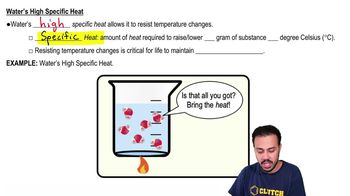
What is specific heat?
Specific heat is the amount of heat energy required to raise or lower one gram of a substance by one degree Celsius.
Why does water resist temperature changes?
Water resists temperature changes because it has a high specific heat, requiring a lot of energy to change its temperature.
How does water's high specific heat benefit living organisms?
It helps maintain homeostasis by allowing cells to resist rapid temperature changes, keeping internal conditions stable.
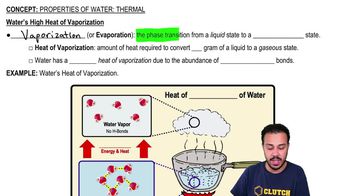
What is the heat of vaporization?
Heat of vaporization is the amount of heat energy required to convert one gram of a liquid into its gaseous state.
Why does water have a high heat of vaporization?
Water has a high heat of vaporization due to the abundance of hydrogen bonds between its molecules in the liquid state.
What must happen to water molecules for liquid water to become water vapor?
A large amount of energy must be applied to break the hydrogen bonds between water molecules, allowing them to escape as vapor.
How does water's high heat of vaporization help maintain life?
It helps keep water in its liquid state, which is essential for life and maintaining homeostasis.
What happens to hydrogen bonds when water vaporizes?
The hydrogen bonds between water molecules are broken, allowing the molecules to move freely as gas.
Why doesn't water boil immediately when heated on a stove?
Because water's high specific heat means it takes a significant amount of energy to raise its temperature to boiling.
How does water's thermal property affect the freezing process?
Water takes a long time to freeze because its high specific heat requires a lot of energy to be removed to lower its temperature.
 BackBack
 04:07
04:07