Skip to main content
Microbiology
My Course
Learn
Exam Prep
AI Tutor
Study Guides
Textbook Solutions
Flashcards
Explore
Try the app
My Course
Learn
Exam Prep
AI Tutor
Study Guides
Textbook Solutions
Flashcards
Explore
Try the app
Back
Properties of Water- Thermal definitions
You can tap to flip the card.
Kinetic Energy
You can tap to flip the card.
👆
Kinetic Energy
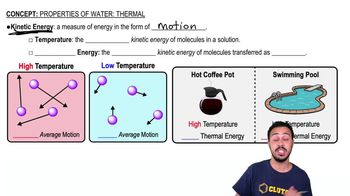
Energy associated with the motion of molecules, influencing both temperature and thermal energy in a substance.
Track progress
Control buttons has been changed to "navigation" mode.
1/14
Related flashcards
Related practice
Recommended videos
Properties of Water- Thermal quiz
Properties of Water- Thermal
15 Terms
Properties of Water- Thermal
4. Water
3 problems
Topic
Nicole
Properties of Water- The Universal Solvent
4. Water
4 problems
Topic
Nicole
4. Water
7 topics
14 problems
Chapter
Nicole
Guided course
04:07
Properties of Water- Thermal
13
views
Guided course
03:25
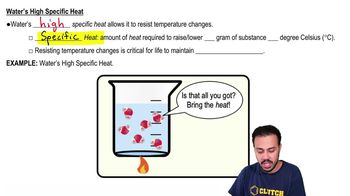
Water’s High Specific Heat
11
views
Guided course
03:37
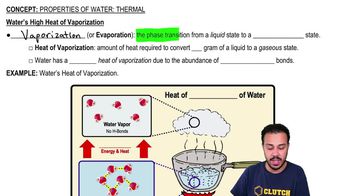
Water’s High Heat of Vaporization
8
views
Terms in this set (14)
Hide definitions
Kinetic Energy
Energy associated with the motion of molecules, influencing both temperature and thermal energy in a substance.
Temperature
Average kinetic energy of molecules in a sample, indicating how fast molecules are moving on average.
Thermal Energy
Total kinetic energy of all molecules in a substance, dependent on both temperature and volume.
Specific Heat
Amount of heat energy required to change the temperature of one gram of a substance by one degree Celsius.
Heat of Vaporization
Amount of heat energy needed to convert one gram of a liquid into its gaseous state.
Hydrogen Bonds
Strong attractions between water molecules that contribute to water's high specific heat and heat of vaporization.
Evaporation
Phase transition where molecules move from the liquid state to the gaseous state, requiring significant energy in water.
Homeostasis
Stable internal conditions maintained by organisms, aided by water's resistance to temperature changes.
Water Vapor
Gaseous form of water, characterized by widely spaced molecules and absence of hydrogen bonds.
Volume
Amount of space occupied by a substance, affecting its total thermal energy regardless of temperature.
Liquid State
Phase where water molecules are densely packed and form hydrogen bonds, crucial for life processes.
Phase Transition
Change of a substance from one state of matter to another, such as from liquid to gas during vaporization.
Heat Energy
Form of energy transferred between substances, driving changes in temperature and state.
Water Molecules
Smallest units of water, capable of forming hydrogen bonds and undergoing phase transitions.
 BackBack
 04:07
04:07