Back

Primary and Secondary Response of Adaptive Immunity quiz

Control buttons has been changed to "navigation" mode.
1/15
  • What is the primary immune response?

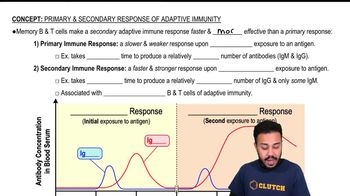
    The primary immune response is the slower and weaker immune response that occurs upon initial exposure to an antigen, producing mainly IgM antibodies over several weeks.
  • Which antibody class is produced first during the primary immune response?

    IgM is the first antibody class produced during the primary immune response.
  • What role do memory B and T cells play in the primary immune response?

    Memory B and T cells do not participate in the primary immune response; they are generated for future exposures.
  • How does the secondary immune response differ from the primary immune response?

    The secondary immune response is much faster and stronger, producing high levels of IgG antibodies and some IgM upon re-exposure to the same antigen.
  • What enables the secondary immune response to be faster and more effective?

    The presence of memory B and T cells enables the secondary immune response to be faster and more effective.
  • What is antibody class switching?

    Antibody class switching is the process by which B cells and plasma cells switch from producing IgM to producing IgG antibodies, making the immune response more effective.
  • How long does it typically take to produce antibodies during the primary immune response?

    It can take multiple weeks to produce antibodies during the primary immune response.
  • What happens to antibody production time during the secondary immune response?

    Antibody production time is significantly reduced, often taking less than a week during the secondary immune response.
  • Which antibody class is produced in higher amounts during the secondary immune response?

    IgG antibodies are produced in higher amounts during the secondary immune response.
  • Why might a person not develop symptoms during a secondary immune response?

    A person might not develop symptoms because the immune system eliminates the antigen quickly, often before symptoms can develop.
  • How does the immune response change with each additional exposure to the same antigen?

    With each additional exposure, the immune response becomes faster and more effective due to the presence of memory cells.
  • What is the main function of memory B and T cells in adaptive immunity?

    Memory B and T cells enable a rapid and robust immune response upon subsequent exposures to the same antigen.
  • What is the significance of IgG antibodies in the secondary immune response?

    IgG antibodies are more effective and are produced in large quantities during the secondary immune response, enhancing antigen elimination.
  • What does the y-axis represent in the graph comparing primary and secondary immune responses?

    The y-axis represents the antibody concentration in the blood serum.
  • What happens to the effectiveness of the immune response after tertiary or further exposures to the same antigen?

    The immune response becomes even better and more effective with each subsequent exposure to the same antigen.