Back

Primary and Secondary Response of Adaptive Immunity definitions

Control buttons has been changed to "navigation" mode.
1/13
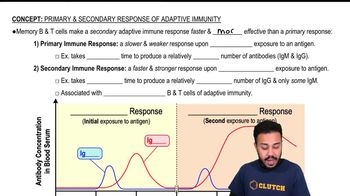
  • Primary Immune Response

    A slower, weaker reaction to an antigen's first exposure, marked by delayed and low antibody production, mainly IgM.
  • Secondary Immune Response

    A rapid, strong reaction upon re-exposure to the same antigen, with quick, high production of mainly IgG antibodies.
  • Antigen

    A foreign molecule that triggers an adaptive immune reaction, leading to antibody production and immune memory.
  • Memory B Cells

    Long-lived lymphocytes that enable faster, stronger antibody production during subsequent encounters with the same antigen.
  • Memory T Cells

    Long-lived lymphocytes that accelerate and enhance cellular immune responses upon repeated antigen exposure.
  • IgM

    The first antibody class produced during an initial immune response, present in low amounts and acting as an early defense.
  • IgG

    A highly effective antibody class produced rapidly and in large quantities during secondary immune responses.
  • Antibody Class Switching

    A process where B cells shift from producing IgM to IgG, increasing the effectiveness of the immune response.
  • Plasma Cells

    Effector B cells that secrete large amounts of antibodies during both primary and secondary immune responses.
  • Adaptive Immunity

    A specific defense system that improves with repeated antigen exposure, involving memory cells and antibody production.
  • Antibody Concentration

    The measurable amount of antibodies present in blood serum, reflecting the strength of an immune response.
  • Exposure

    Contact with an antigen that initiates an immune response, leading to antibody production and immune memory formation.
  • Signs and Symptoms

    Observable effects of infection that may be prevented during a rapid and effective secondary immune response.