What is the main photosynthetic pigment found in chloroplasts?
The main photosynthetic pigment is chlorophyll a, which is responsible for absorbing light energy to power photosynthesis.
What is the difference between chlorophyll and chloroplast?
Chlorophyll is a pigment molecule that absorbs light, while chloroplast is the organelle where photosynthesis occurs.
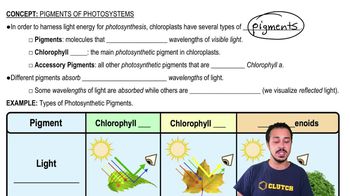
What are accessory pigments in photosynthesis?
Accessory pigments are all photosynthetic pigments other than chlorophyll a, such as chlorophyll b and carotenoids, which help absorb additional wavelengths of light.
Why do plants appear green to our eyes?
Plants appear green because chlorophyll a reflects green wavelengths of light, which is the color we perceive.
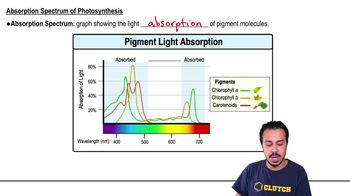
What is an absorption spectrum in the context of photosynthesis?
An absorption spectrum is a graph showing how much light is absorbed by pigment molecules at different wavelengths.
Which wavelengths of light are mainly reflected by chlorophyll a?
Chlorophyll a mainly reflects green and blue wavelengths of light.
What color does chlorophyll b primarily reflect, and how does this affect its appearance?
Chlorophyll b primarily reflects yellow and green wavelengths, making it appear yellowish to our eyes.
Which pigments are responsible for reflecting orange, red, and yellow wavelengths?
Carotenoids are responsible for reflecting orange, red, and yellow wavelengths, giving them their characteristic colors.
What is the function of pigments in photosynthesis?
Pigments absorb specific wavelengths of light, which provides the energy needed to drive photosynthesis.
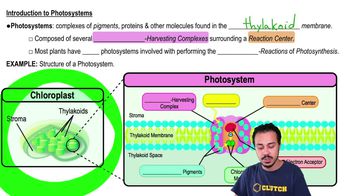
Where are photosystems located within the chloroplast?
Photosystems are located in the thylakoid membranes inside the chloroplast.
What are the main components of a photosystem?
A photosystem consists of pigment-protein complexes, including light-harvesting complexes and a reaction center.
What role do accessory pigments play in the light-harvesting complex?
Accessory pigments in the light-harvesting complex absorb photons of light and help transfer energy to the reaction center.
What is found at the reaction center of a photosystem?
The reaction center contains chlorophyll a molecules and a primary electron acceptor, which are crucial for converting light energy into chemical energy.
How many types of photosystems are typically found in plants?
Most plants have two types of photosystems, both essential for the light-dependent reactions of photosynthesis.
Why are some wavelengths of light reflected rather than absorbed by pigments?
Wavelengths that are not absorbed by pigments are reflected, and these reflected wavelengths determine the color we see in plants.
 Back
Back
 05:58
05:58