Skip to main content
Microbiology
My Course
Learn
Exam Prep
AI Tutor
Study Guides
Textbook Solutions
Flashcards
Explore
Try the app
My Course
Learn
Exam Prep
AI Tutor
Study Guides
Textbook Solutions
Flashcards
Explore
Try the app
Back
Pigments of Photosynthesis definitions
You can tap to flip the card.
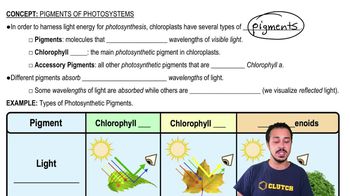
Chlorophyll a
You can tap to flip the card.
👆
Chlorophyll a
Main photosynthetic molecule in chloroplasts, reflects green and blue light, and is essential for capturing energy to drive photosynthesis.
Track progress
Control buttons has been changed to "navigation" mode.
1/14
Related flashcards
Related practice
Recommended videos
Pigments of Photosynthesis quiz
Pigments of Photosynthesis
15 Terms
Pigments of Photosynthesis
13. Photosynthesis
4 problems
Topic
Brendan
Stages of Photosynthesis
13. Photosynthesis
3 problems
Topic
Nicole
13. Photosynthesis
9 topics
12 problems
Chapter
Brendan
Guided course
05:58
Pigments of Photosynthesis
4
views
Guided course
04:59
Introduction to Photosystems
3
views
Guided course
02:52
Absorption Spectrum of Photosynthesis
3
views
Terms in this set (14)
Hide definitions
Chlorophyll a
Main photosynthetic molecule in chloroplasts, reflects green and blue light, and is essential for capturing energy to drive photosynthesis.
Chlorophyll b
Accessory molecule found in smaller amounts than the main pigment, reflects yellow and green light, and broadens the range of light absorption.
Carotenoids
Accessory molecules reflecting orange, red, and yellow light, contributing to plant coloration and expanding the spectrum of absorbed light.
Accessory pigments
Molecules other than the main pigment that absorb additional wavelengths, enhancing the efficiency of light capture in photosynthesis.
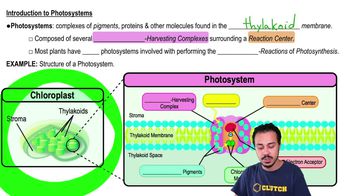
Chloroplast
Organelle in plant cells where photosynthesis occurs, containing pigment molecules and specialized internal structures.
Thylakoid
Membranous, pancake-like structure inside the organelle, housing pigment-protein complexes crucial for light absorption.
Photosystem
Complex of pigments and proteins in the thylakoid membrane, organized to capture light and initiate energy conversion.
Light-harvesting complex
Group of pigment molecules surrounding a central region, funneling absorbed energy toward the core for conversion.
Reaction center
Central part of a pigment-protein complex where energy from absorbed light is converted into chemical energy.
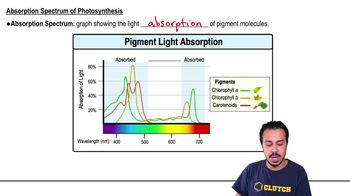
Absorption spectrum
Graphical representation showing how much light at different wavelengths is absorbed by pigment molecules.
Wavelength
Specific distance between peaks of light waves, determining the color and energy of light absorbed or reflected by pigments.
Visible light
Range of electromagnetic radiation detectable by the human eye, utilized by pigment molecules for energy capture.
Mesophyll cell
Type of leaf tissue cell containing organelles where photosynthesis and pigment localization occur.
Stroma
Fluid-filled region inside the organelle but outside the internal membrane stacks, surrounding the sites of light reactions.
 BackBack
 05:58
05:58