Back

Physical Barriers in First-Line Defenses: Skin quiz

Control buttons has been changed to "navigation" mode.
1/15
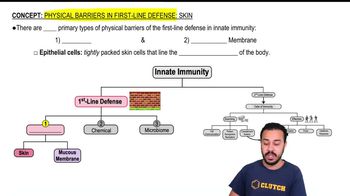
  • What are the two primary physical barriers in the first line of defense of innate immunity?

    The two primary physical barriers are the skin and mucus membranes.
  • What are the two main layers of the skin?

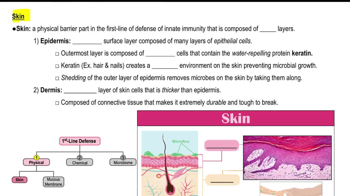
    The two main layers of the skin are the epidermis and the dermis.
  • What type of cells make up the outermost layer of the epidermis?

    The outermost layer of the epidermis is made up of dead skin cells.
  • What protein is found in the outermost layer of the epidermis and what is its function?

    Keratin is found in the outermost layer, and it helps create a dry environment that inhibits microbial growth.
  • How does the shedding of the epidermis help protect against microbes?

    Shedding removes microbes from the skin by taking them away with the dead skin cells.
  • Why is the dermis considered a strong barrier against microbial penetration?

    The dermis is composed of durable connective tissue, making it tough to break and preventing microbes from penetrating.
  • What is located beneath the dermis and what does it contain?

    Beneath the dermis is the subcutaneous layer, which contains fat tissue and blood vessels.
  • How does keratin contribute to the skin’s role as a physical barrier?

    Keratin repels water and creates a dry environment, which inhibits the growth of many microbes.
  • Why can some microbes grow on the skin despite its defenses?

    Some microbes can tolerate dry environments and are able to grow on the skin.
  • What is the primary function of the skin in innate immunity?

    The skin acts as a physical barrier to prevent microbial entry and infection.
  • What type of tissue makes up the dermis?

    The dermis is made up of connective tissue.
  • How do epithelial cells contribute to the skin’s protective function?

    Epithelial cells are tightly packed, forming a continuous barrier that lines the body’s surfaces.
  • What is the significance of the skin’s dry environment?

    A dry environment on the skin inhibits the growth of microbes that cannot tolerate dryness.
  • What is the role of the subcutaneous layer in skin defense?

    The subcutaneous layer adds another layer of protection with fat tissue and blood vessels.
  • How does the structure of the skin support its function as a first-line defense?

    The skin’s multiple layers, keratinized cells, and durable connective tissue work together to prevent microbial entry.