Back

Outcomes of Antibody Binding to Antigen quiz

Control buttons has been changed to "navigation" mode.
1/15
  • What is opsonization in the context of antibody binding to antigen?

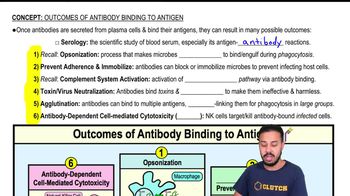
    Opsonization is the process where antibodies make microbes easier to bind and engulf by phagocytes, enhancing phagocytosis.
  • How do antibodies prevent microbes from causing harm to host cells?

    Antibodies block microbes from adhering to host cells and can immobilize them, reducing infection risks.
  • Which pathway is activated when antibodies bind to antigens and trigger the complement system?

    The classical pathway of the complement system is activated by antibody-antigen binding.
  • What is the outcome of complement system activation by antibodies?

    Complement activation leads to inflammation and cell lysis, helping eliminate pathogens.
  • How do antibodies neutralize toxins and viruses?

    Antibodies bind to toxins and viruses, rendering them ineffective and harmless.
  • What is agglutination in antibody-antigen reactions?

    Agglutination is the clumping of antigens by antibodies, making them easier to phagocytose in large groups.
  • How do antibodies facilitate agglutination?

    Antibodies have multiple binding sites and can cross-link different antigens, causing clumping.
  • What is antibody-dependent cell-mediated cytotoxicity (ADCC)?

    ADCC is a process where natural killer cells target and kill antibody-bound infected host cells.
  • What role do natural killer cells play in ADCC?

    Natural killer cells detect antibody-bound infected cells and release signals to trigger apoptosis.
  • What is the scientific study of blood serum and its antigen-antibody reactions called?

    This study is called serology.
  • How do antibodies immobilize microbes?

    Antibodies bind to structures like flagella, preventing microbes from moving in their environment.
  • What is the benefit of agglutination for the immune system?

    Agglutination allows phagocytes to target and eliminate pathogens more efficiently in groups.
  • What happens to infected host cells during ADCC?

    Infected host cells bound by antibodies are killed by natural killer cells through apoptosis.
  • How do antibodies enhance phagocytosis?

    By binding to antigens, antibodies make microbes easier for phagocytes to recognize and engulf.
  • What is the main protective outcome of antibody binding to antigen?

    Antibody binding leads to various outcomes like opsonization, neutralization, complement activation, agglutination, and ADCC, all providing immunity.