Skip to main content
Microbiology
My Course
Learn
Exam Prep
AI Tutor
Study Guides
Textbook Solutions
Flashcards
Explore
Try the app
My Course
Learn
Exam Prep
AI Tutor
Study Guides
Textbook Solutions
Flashcards
Explore
Try the app
Back
Noncovalent Bonds quiz
You can tap to flip the card.
What is the main difference between covalent and noncovalent bonds?
You can tap to flip the card.
👆
What is the main difference between covalent and noncovalent bonds?
Covalent bonds involve sharing of electrons, while noncovalent bonds do not involve electron sharing.
Track progress
Control buttons has been changed to "navigation" mode.
1/15
Related flashcards
Related practice
Recommended videos
Noncovalent Bonds definitions
Noncovalent Bonds
13 Terms
Noncovalent Bonds
3. Chemical Principles of Microbiology
3 problems
Topic
Monica
Ionic Bonding
3. Chemical Principles of Microbiology
3 problems
Topic
Nicole
3. Chemical Principles of Microbiology
7 topics
12 problems
Chapter
Nicole
03:14
Noncovalent Bonds
21
views
1
rank
Terms in this set (15)
Hide definitions
What is the main difference between covalent and noncovalent bonds?
Covalent bonds involve sharing of electrons, while noncovalent bonds do not involve electron sharing.
How are noncovalent bonds defined in terms of atomic interactions?
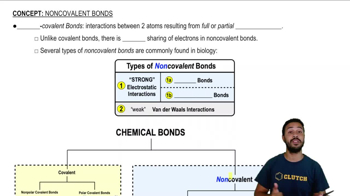
Noncovalent bonds are interactions between two atoms resulting from full or partial charges.
What are the two major groups of noncovalent bonds?
Noncovalent bonds are categorized into strong electrostatic interactions and weak Van Der Waals interactions.
Which group of noncovalent bonds will be the focus in biology courses?
Biology courses focus mainly on strong electrostatic interactions, specifically ionic and hydrogen bonds.
What types of strong electrostatic interactions are common in biology?
The two types are ionic bonds and hydrogen bonds.
Will weak Van Der Waals interactions be covered in this biology course?
No, weak Van Der Waals interactions will be covered more extensively in chemistry courses.
What does the term 'covalent' refer to in chemical bonding?
Covalent refers to the sharing of electrons between atoms.
What does adding 'non' in front of 'covalent' indicate about electron sharing?
It indicates that there is no sharing of electrons in noncovalent bonds.
What is the next topic after covalent bonds in the lesson map?
The next topic is noncovalent bonds.
Which two types of covalent bonds were previously discussed?
Nonpolar covalent and polar covalent bonds were previously discussed.
What is the first type of strong electrostatic interaction to be discussed in future lessons?
Ionic bonds will be discussed first.
After ionic bonds, which type of bond will be discussed?
Hydrogen bonds will be discussed after ionic bonds.
What is the main characteristic of noncovalent bonds regarding electron sharing?
Noncovalent bonds do not involve sharing of electrons.
Where will students learn more about weak Van Der Waals interactions?
Students will learn more about weak Van Der Waals interactions in chemistry courses.
What is the focus of the biology course regarding noncovalent bonds?
The focus is on strong electrostatic interactions, specifically ionic and hydrogen bonds.
 BackBack
 03:14
03:14