Skip to main content
Microbiology
My Course
Learn
Exam Prep
AI Tutor
Study Guides
Textbook Solutions
Flashcards
Explore
Try the app
My Course
Learn
Exam Prep
AI Tutor
Study Guides
Textbook Solutions
Flashcards
Explore
Try the app
Back
Noncovalent Bonds definitions
You can tap to flip the card.
Noncovalent Bonds
You can tap to flip the card.
👆
Noncovalent Bonds
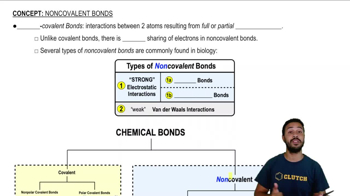
Interactions between atoms resulting from full or partial charges, without any sharing of electrons.
Track progress
Control buttons has been changed to "navigation" mode.
1/13
Related flashcards
Related practice
Recommended videos
Noncovalent Bonds quiz
Noncovalent Bonds
15 Terms
Noncovalent Bonds
3. Chemical Principles of Microbiology
3 problems
Topic
Monica
Ionic Bonding
3. Chemical Principles of Microbiology
3 problems
Topic
Nicole
3. Chemical Principles of Microbiology
7 topics
12 problems
Chapter
Nicole
03:14
Noncovalent Bonds
21
views
1
rank
Terms in this set (13)
Hide definitions
Noncovalent Bonds
Interactions between atoms resulting from full or partial charges, without any sharing of electrons.
Covalent Bonds
Connections between atoms involving the sharing of electrons, forming strong chemical links.
Electrostatic Interactions
Attractions or repulsions between charged particles, forming the basis for certain strong noncovalent bonds.
Van Der Waals Interactions
Weak attractions between molecules due to temporary partial charges, less emphasized in biology courses.
Ionic Bonds
Strong attractions between oppositely charged ions, classified as a type of noncovalent bond.
Hydrogen Bonds
Attractions involving a hydrogen atom and an electronegative atom, important in biological molecules.
Partial Charges
Uneven distribution of electrons in a molecule, leading to regions with slight positive or negative character.
Full Charges
Complete separation of electrical charge, resulting in distinct positive and negative ions.
Chemical Bonds Map
A visual guide outlining the relationships and categories of different chemical bonds discussed in lessons.
Nonpolar Covalent Bonds
Connections where electrons are shared equally between atoms, resulting in no charge separation.
Polar Covalent Bonds
Connections where electrons are shared unequally, creating regions of partial positive and negative charge.
Atoms
Basic units of matter that interact to form various types of chemical bonds, including noncovalent ones.
Ions
Atoms or molecules carrying a net electrical charge due to loss or gain of electrons, central to ionic bonds.
 BackBack
 03:14
03:14