Back

Mitosis & Meiosis quiz

Control buttons has been changed to "navigation" mode.
1/15
  • What is mitosis and in what type of cells does it occur?

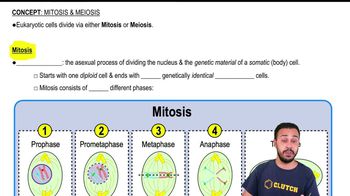
    Mitosis is the asexual division of the nucleus and genetic material, occurring in somatic (body) cells.
  • How many genetically identical cells are produced at the end of mitosis, and what is their ploidy?

    Mitosis produces two genetically identical diploid cells, each with two copies of every chromosome.
  • What are the five phases of mitosis in order?

    The five phases of mitosis are prophase, prometaphase, metaphase, anaphase, and telophase.
  • What key event occurs during prophase of mitosis?

    During prophase, chromatin condenses into visible chromosomes and the mitotic spindle begins to form.
  • What happens to the nuclear envelope during prometaphase?

    The nuclear envelope breaks down, and the mitotic spindle attaches to chromosomes at kinetochores.
  • What is the main event of metaphase in mitosis?

    All chromosomes line up in a single file at the middle of the cell.
  • During which phase are sister chromatids separated in mitosis?

    Sister chromatids are separated during anaphase.
  • What major changes occur during telophase in mitosis?

    The nuclear envelope reforms, the mitotic spindle breaks down, and chromosomes uncoil back into chromatin.
  • What is cytokinesis and when does it occur?

    Cytokinesis is the division of the cell's cytoplasm, occurring after telophase to produce two separate cells.
  • What mnemonic helps remember the order of mitosis phases?

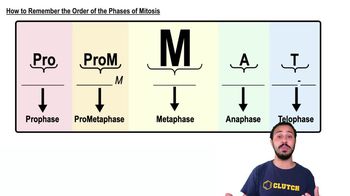
    The mnemonic uses the first letters: Pro (before) for prophase and prometaphase, M (middle) for metaphase, A (after) for anaphase, and T (tail end) for telophase.
  • What is meiosis and what type of cells does it produce?

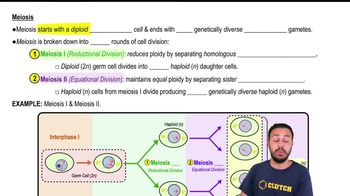
    Meiosis is the process by which a diploid germ cell divides to produce four genetically diverse haploid gametes (sex cells).
  • How many rounds of cell division occur in meiosis and what are they called?

    Meiosis involves two rounds of cell division: meiosis I (reductional division) and meiosis II (equational division).
  • What is the main event of meiosis I?

    Meiosis I separates homologous chromosomes, reducing the chromosome number from diploid to haploid.
  • What happens during meiosis II?

    Meiosis II separates sister chromatids, maintaining the haploid state and resulting in four haploid gametes.
  • Why is meiosis important for sexual reproduction?

    Meiosis produces genetically diverse gametes, ensuring genetic variation in offspring.