Back

Liquid Chemicals: Alcohols, Aldehydes, & Biguanides quiz

Control buttons has been changed to "navigation" mode.
1/15
  • What is the functional group present in alcohols that defines them as such?

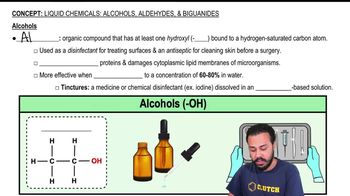
    Alcohols contain at least one hydroxyl group, which consists of an oxygen and hydrogen atom bound to a carbon.
  • How do alcohols kill microorganisms?

    Alcohols denature proteins and damage cytoplasmic lipid membranes, leading to microbial death.
  • At what concentration are alcohols most effective as disinfectants?

    Alcohols are most effective when diluted to 60-80% in water.
  • What is a tincture in the context of alcohols?

    A tincture is a medicine or chemical disinfectant, such as iodine, dissolved in an alcohol-based solution.
  • Which alcohol is commonly used in labs and hospitals for disinfecting surfaces and skin?

    Ethanol is commonly used in labs and hospitals for disinfecting surfaces and skin before surgeries.
  • What is the main use of alcohols as antiseptics?

    Alcohols are used as antiseptics to clean human skin before surgeries.
  • What functional group characterizes aldehydes?

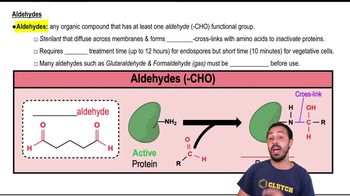
    Aldehydes have a functional group consisting of a carbon, hydrogen, and oxygen atom.
  • How do aldehydes destroy microbes?

    Aldehydes form amide cross-links with amino acids on proteins, inactivating them and destroying microbes.
  • What is the typical treatment time required for aldehydes to destroy endospores?

    Aldehydes require up to 12 hours to destroy endospores due to their resistance.
  • Name two common aldehydes used as sterilants.

    Glutaraldehyde and formaldehyde are two common aldehydes used as sterilants.
  • What must be done to aldehydes before their use as sterilants?

    Aldehydes must be diluted before use as sterilants.
  • What is the chemical formula for biguanide?

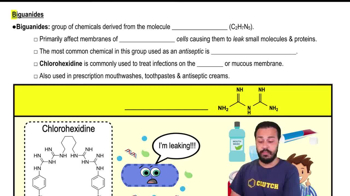
    The chemical formula for biguanide is C2H7N5.
  • How do biguanides affect vegetative cells?

    Biguanides disrupt the membranes of vegetative cells, causing leakage of small molecules and proteins.
  • What is the most common biguanide used as an antiseptic?

    Chlorohexidine is the most common biguanide used as an antiseptic.
  • In what products are biguanides like chlorohexidine commonly found?

    Biguanides such as chlorohexidine are found in prescription mouthwashes, toothpastes, and antiseptic creams.