Back

Introduction to Epidemiology quiz

Control buttons has been changed to "navigation" mode.
1/15
  • What is epidemiology?

    Epidemiology is the study of the distribution, patterns, and determinants of health and disease in human populations.
  • What is the main mission of public health?

    The main mission of public health is to protect and improve the health of the entire human population.
  • What does etiology study?

    Etiology is the study of the cause or origin of a disease.
  • Which organizations are responsible for disease prevention in the USA and internationally?

    The Centers for Disease Control and Prevention (CDC) is responsible in the USA, and the World Health Organization (WHO) is responsible internationally.
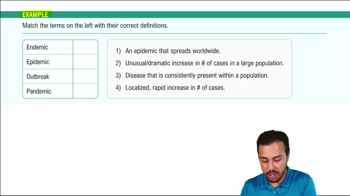
  • What is a sporadic disease?

    A sporadic disease is one that is only occasionally present in the population, typically in isolated or scattered groups with an irregular pattern.
  • How is an endemic disease defined?

    An endemic disease is always or constantly present in a population, showing a regular or predictable pattern.
  • What is an epidemic?

    An epidemic is a disease that has an unusually high number of cases in a population, often following an outbreak.
  • How does a pandemic differ from an epidemic?

    A pandemic is an epidemic that spreads around the entire world, affecting multiple populations globally.
  • What does morbidity refer to?

    Morbidity refers to the state of having an illness or disease, but does not include death.
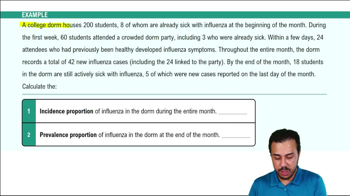
  • How is incidence different from prevalence?

    Incidence is the number of new disease cases during a specific time period, while prevalence is the total number of all disease cases at a specific time.
  • How do you calculate incidence proportion?

    Incidence proportion is calculated by dividing the number of new disease cases by the initial population at risk, then multiplying by 100%.
  • How is prevalence proportion calculated?

    Prevalence proportion is calculated by dividing the total number of disease cases (new and preexisting) by the total population at that time, then multiplying by 100%.
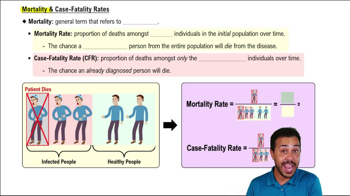
  • What does mortality rate measure?

    Mortality rate is the proportion of deaths among all individuals in the initial population over time.
  • What is the case fatality rate (CFR)?

    Case fatality rate is the proportion of deaths among only the diagnosed individuals over time.
  • Why do epidemiologists prefer proportions over raw counts?

    Proportions standardize raw counts to population size, making comparisons more meaningful and less misleading.