Skip to main content
Microbiology
My Course
Learn
Exam Prep
AI Tutor
Study Guides
Textbook Solutions
Flashcards
Explore
Try the app
My Course
Learn
Exam Prep
AI Tutor
Study Guides
Textbook Solutions
Flashcards
Explore
Try the app
Back
Introduction to DNA Repair quiz
You can tap to flip the card.
Why are DNA repair mechanisms important for cells?
You can tap to flip the card.
👆
Why are DNA repair mechanisms important for cells?
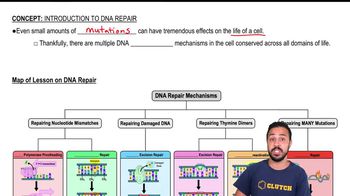
Even small mutations in DNA can have tremendous effects on cell life, so repair mechanisms are crucial for maintaining cellular health.
Track progress
Control buttons has been changed to "navigation" mode.
1/15
Related flashcards
Related practice
Recommended videos
Introduction to DNA Repair definitions
Introduction to DNA Repair
13 Terms
Introduction to DNA Repair
16. Microbial Genetics
2 problems
Topic
Nicole
DNA Repair Mechanisms
16. Microbial Genetics
5 problems
Topic
Nicole
16. Microbial Genetics - Part 1 of 2
9 topics
14 problems
Chapter
Monica
16. Microbial Genetics - Part 2 of 2
8 topics
13 problems
Chapter
Nicole
Guided course
02:47
Introduction to DNA Repair
1
views
Terms in this set (15)
Hide definitions
Why are DNA repair mechanisms important for cells?
Even small mutations in DNA can have tremendous effects on cell life, so repair mechanisms are crucial for maintaining cellular health.
Are DNA repair mechanisms conserved across all domains of life?
Yes, multiple DNA repair mechanisms are conserved across all domains of life.
How many main groups are DNA repair mechanisms categorized into in this lesson?
DNA repair mechanisms are categorized into four main groups.
What is the first group of DNA repair mechanisms discussed in the lesson?
The first group discussed is mechanisms that repair nucleotide mismatches.
Which two mechanisms are included in nucleotide mismatch repair?
Nucleotide mismatch repair includes DNA Polymerase proofreading and mismatch repair.
What type of DNA damage does base excision repair address?
Base excision repair addresses damaged DNA.
Which repair mechanism is used for thymine dimers?
Nucleotide excision repair is used for thymine dimers.
What is photo reactivation used for in DNA repair?
Photo reactivation is used to repair thymine dimers.
What mechanism repairs extensive DNA damage and many mutations?
SOS repair is used for repairing extensive DNA damage and many mutations.
What is the first DNA repair mechanism that will be discussed in detail?
The first mechanism discussed in detail will be DNA polymerase proofreading.
What does the lesson map help students do?
The lesson map helps guide students through the different DNA repair mechanisms covered in the course.
What happens after nucleotide mismatch repair is discussed?
After nucleotide mismatch repair, the lesson moves on to base excision repair for damaged DNA.
Which repair mechanism follows the discussion of base excision repair?
Nucleotide excision repair for thymine dimers follows base excision repair.
What is the final topic in the DNA repair lesson map?
The final topic is SOS repair for extensive damage and many mutations.
Will each DNA repair mechanism be covered in a single video or multiple videos?
Each DNA repair mechanism will be explored in its own individual, separate video.
 BackBack
 02:47
02:47