Skip to main content
Microbiology
My Course
Learn
Exam Prep
AI Tutor
Study Guides
Textbook Solutions
Flashcards
Explore
Try the app
My Course
Learn
Exam Prep
AI Tutor
Study Guides
Textbook Solutions
Flashcards
Explore
Try the app
Back
Introduction to DNA Repair definitions
You can tap to flip the card.
DNA Repair
You can tap to flip the card.
👆
DNA Repair
Cellular processes that correct alterations in genetic material to maintain genome stability and cell survival.
Track progress
Control buttons has been changed to "navigation" mode.
1/13
Related flashcards
Related practice
Recommended videos
Introduction to DNA Repair quiz
Introduction to DNA Repair
15 Terms
Introduction to DNA Repair
16. Microbial Genetics
2 problems
Topic
Nicole
DNA Repair Mechanisms
16. Microbial Genetics
5 problems
Topic
Nicole
16. Microbial Genetics - Part 1 of 2
9 topics
14 problems
Chapter
Monica
16. Microbial Genetics - Part 2 of 2
8 topics
13 problems
Chapter
Nicole
Guided course
02:47
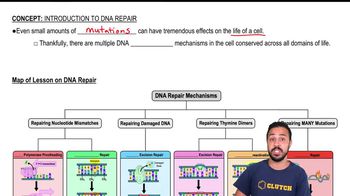
Introduction to DNA Repair
1
views
Terms in this set (13)
Hide definitions
DNA Repair
Cellular processes that correct alterations in genetic material to maintain genome stability and cell survival.
Mutation
A change in the DNA sequence that can significantly impact cellular function and viability.
Nucleotide Mismatch
An incorrect pairing of bases in DNA, potentially leading to errors if not corrected.
DNA Polymerase Proofreading
A mechanism where the enzyme checks and corrects errors during DNA synthesis for accuracy.
Mismatch Repair
A system that identifies and fixes incorrectly paired nucleotides missed during replication.
Damaged DNA
Genetic material altered by physical or chemical agents, requiring specialized correction systems.
Base Excision Repair
A pathway that removes and replaces damaged or incorrect bases in the DNA molecule.
Thymine Dimer
A lesion formed when two adjacent thymine bases bond, often due to UV exposure, distorting DNA structure.
Nucleotide Excision Repair
A process that removes bulky DNA lesions, such as thymine dimers, by excising a short single-stranded segment.
Photo Reactivation
A light-dependent mechanism that directly reverses thymine dimers, restoring normal DNA structure.
SOS Repair
An emergency response system that allows cells to bypass extensive DNA damage, often with reduced fidelity.
Genome Stability
The preservation of DNA sequence and structure, essential for proper cellular function and inheritance.
Cell Viability
The ability of a cell to survive and function, often threatened by uncorrected DNA damage.
 BackBack
 02:47
02:47