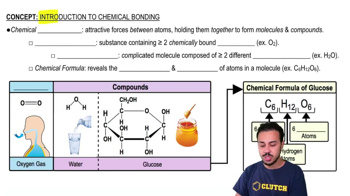
A chemical bond is an attractive force between atoms that holds them together to form molecules or compounds.
What is the difference between a molecule and a compound?
A molecule contains at least two chemically bound atoms, which can be the same or different elements, while a compound is a molecule made of at least two different elements.
Is O2 (oxygen gas) a molecule, a compound, or both?
O2 is a molecule because it has two chemically bound atoms, but it is not a compound since both atoms are the same element.
Why is water (H2O) considered a compound?
Water is a compound because it contains at least two different elements: hydrogen and oxygen.
What does a chemical formula show?
A chemical formula reveals both the number and type of atoms present in a molecule or compound.
How many carbon, hydrogen, and oxygen atoms are in a glucose molecule (C6H12O6)?
Glucose has 6 carbon atoms, 12 hydrogen atoms, and 6 oxygen atoms.
What are intramolecular bonds?
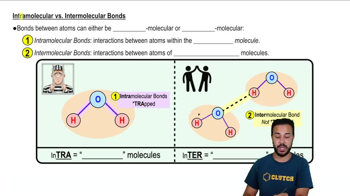
Intramolecular bonds are interactions between atoms within the same molecule.
What are intermolecular bonds?
Intermolecular bonds are interactions between atoms of different molecules.
How can you remember the difference between intramolecular and intermolecular bonds?
Intramolecular bonds are 'trapped' within the same molecule, while intermolecular bonds form between different molecules.
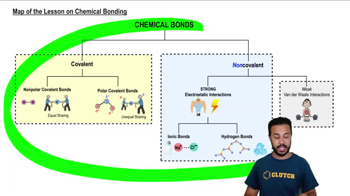
What are the two main categories of chemical bonds discussed in this lesson?
The two main categories are covalent bonds and noncovalent bonds.
What are the two types of covalent bonds?
The two types of covalent bonds are nonpolar covalent bonds and polar covalent bonds.
What types of bonds are included in noncovalent bonds?
Noncovalent bonds include ionic bonds and hydrogen bonds.
Why are chemical formulas useful?
Chemical formulas are useful because they allow us to quickly represent the number and types of atoms in a molecule or compound without drawing the full structure.
Is glucose a molecule, a compound, or both? Why?
Glucose is both a molecule and a compound because it contains at least two chemically bound atoms of different elements.
What is the next topic after the introduction to chemical bonding according to the lesson map?
The next topic is covalent chemical bonds, starting with nonpolar covalent bonds.
 Back
Back
 04:01
04:01