Skip to main content
Microbiology
My Course
Learn
Exam Prep
AI Tutor
Study Guides
Textbook Solutions
Flashcards
Explore
Try the app
My Course
Learn
Exam Prep
AI Tutor
Study Guides
Textbook Solutions
Flashcards
Explore
Try the app
Back
Introduction to Chemical Bonding definitions
You can tap to flip the card.
Chemical Bond
You can tap to flip the card.
👆
Chemical Bond
Attractive force holding atoms together, enabling the formation of molecules and compounds with distinct properties.
Track progress
Control buttons has been changed to "navigation" mode.
1/14
Related flashcards
Related practice
Recommended videos
Introduction to Chemical Bonding quiz
Introduction to Chemical Bonding
15 Terms
Introduction to Chemical Bonding
3. Chemical Principles of Microbiology
6 problems
Topic
Brendan
Covalent Bonds
3. Chemical Principles of Microbiology
4 problems
Topic
Monica
3. Chemical Principles of Microbiology
7 topics
12 problems
Chapter
Nicole
Guided course
03:53
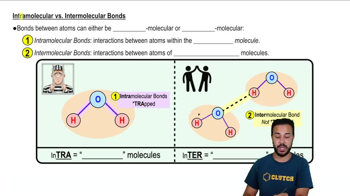
Intramolecular vs. Intermolecular Bonds
24
views
Guided course
02:42
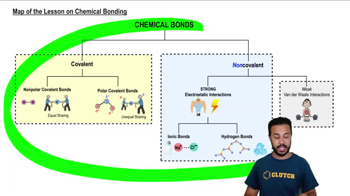
Map of the Lesson on Chemical Bonding
12
views
Guided course
06:53
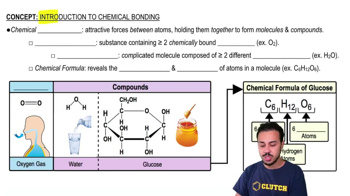
Introduction to Chemical Bonding
29
views
Terms in this set (14)
Hide definitions
Chemical Bond
Attractive force holding atoms together, enabling the formation of molecules and compounds with distinct properties.
Molecule
Substance containing two or more chemically bound atoms, which may be of the same or different elements.
Compound
Specific molecule type composed of at least two different elements chemically bonded together.
Element
Pure substance consisting of only one type of atom, such as hydrogen, oxygen, or carbon.
Atom
Smallest unit of an element, serving as the fundamental building block for molecules and compounds.
Chemical Formula
Notation revealing the number and type of atoms present in a molecule or compound, such as H2O or C6H12O6.
Intramolecular Bond
Interaction occurring between atoms within the same molecule, effectively 'trapping' them together.
Intermolecular Bond
Interaction occurring between atoms of different molecules, connecting separate molecular units.
Covalent Bond
Type of chemical bond where atoms share electron pairs, forming stable connections within molecules.
Nonpolar Covalent Bond
Covalent bond with equal sharing of electrons between atoms, resulting in no charge separation.
Polar Covalent Bond
Covalent bond with unequal electron sharing, creating partial positive and negative charges within the molecule.
Noncovalent Bond
Chemical interaction not involving electron sharing, including ionic and hydrogen bonds.
Ionic Bond
Strong electrostatic attraction between oppositely charged ions, often forming crystalline structures.
Hydrogen Bond
Weak attraction between a hydrogen atom in one molecule and an electronegative atom in another molecule.
 BackBack
 03:53
03:53