Back

Introduction to Antimicrobial Drugs quiz

Control buttons has been changed to "navigation" mode.
1/15
  • What is selective toxicity in antimicrobial drugs?

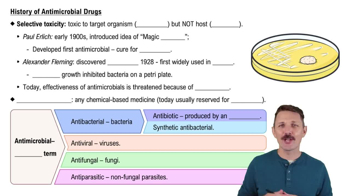
    Selective toxicity means the drug kills the pathogen without harming the host. It is the foundational concept for antimicrobial drug development.
  • Who is credited with introducing the concept of the 'magic bullet' in antimicrobial drug history?

    Paul Ehrlich introduced the 'magic bullet' concept, searching for chemicals that selectively kill microbes without harming humans.
  • What disease was the first antimicrobial drug developed by Paul Ehrlich used to treat?

    Paul Ehrlich's first antimicrobial drug was used to cure syphilis. It was a major breakthrough at the time.
  • Who discovered penicillin, the first true antibiotic?

    Alexander Fleming discovered penicillin in 1928. It was first widely used in the 1940s.
  • How did Alexander Fleming discover penicillin?

    Fleming noticed that penicillium mold inhibited bacterial growth on a Petri plate. He realized the mold produced a chemical, penicillin, that killed bacteria.
  • What is the main threat to the effectiveness of antibiotics today?

    The spread of resistance threatens antibiotic effectiveness. This means some infections may become untreatable in the future.
  • What does the term 'chemotherapy' mean in microbiology?

    Chemotherapy refers to any chemical-based medicine used to treat microbes. It is not limited to cancer treatments in this context.
  • What is an antimicrobial?

    An antimicrobial is a general term for any drug that treats a microbe. It can target bacteria, viruses, fungi, or parasites.
  • What are the four main types of antimicrobials based on the type of microbe they target?

    The four main types are antibacterials, antivirals, antifungals, and antiparasitics. Each targets a specific group of pathogens.
  • What is the technical definition of an antibiotic?

    An antibiotic is an antibacterial drug produced by an organism. Penicillin, made by mold, is an example.
  • How do synthetic antibacterials differ from antibiotics?

    Synthetic antibacterials are made in a lab and are not naturally occurring. Antibiotics are produced by living organisms.
  • Why is it important to understand the vocabulary related to antimicrobial drugs?

    Understanding terms like chemotherapy, antimicrobials, and antibiotic resistance is crucial for effective treatment of infectious diseases. It helps clarify drug mechanisms and usage.
  • What does the term 'antiparasitic' refer to?

    Antiparasitic drugs treat infections caused by nonfungal parasites or nonfungal eukaryotes. They are a specific type of antimicrobial.
  • Why are selectively toxic drugs hard to find?

    It's difficult to find chemicals that kill microbes without harming human cells. This challenge drives ongoing research in drug development.
  • How has the use of antibiotics changed since their discovery?

    Antibiotics were once reliably effective for bacterial infections, but resistance now threatens their usefulness. This has become a major concern in modern medicine.