Back

Inhibitors of Protein Synthesis quiz

Control buttons has been changed to "navigation" mode.
1/15
  • What is the main reason antibiotics that inhibit protein synthesis are selectively toxic to bacteria and not humans?

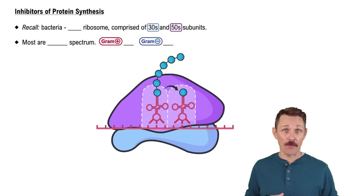
    They target the bacterial 70S ribosome, which is structurally different from the human 80S ribosome.
  • Which ribosomal subunit do tetracyclines target, and what is their mechanism of action?

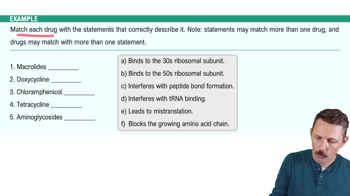
    Tetracyclines bind to the 30S subunit and block tRNA binding, preventing protein synthesis.
  • How do aminoglycosides inhibit bacterial protein synthesis?

    Aminoglycosides bind to the 30S subunit and cause mistranslation, leading to the production of faulty proteins.
  • Why are aminoglycosides especially effective against Gram-negative bacteria?

    They are attracted to and bind to the lipopolysaccharides on the outer membrane of Gram-negative bacteria.
  • What is the mechanism of action of chloramphenicol?

    Chloramphenicol binds to the 50S subunit and inhibits the formation of peptide bonds between amino acids.
  • Why is chloramphenicol not commonly used today despite being inexpensive?

    It can cause serious side effects, including inhibition of bone marrow, which can be fatal.
  • Which antibiotics are classified as macrolides, and what is their mechanism?

    Macrolides like erythromycin and azithromycin bind to the 50S subunit and block the exit of the growing polypeptide chain.
  • What happens to protein synthesis when macrolides block the polypeptide exit tunnel?

    The growing amino acid chain cannot exit the ribosome, halting protein synthesis.
  • What are broad-spectrum antibiotics, and which protein synthesis inhibitors fall into this category?

    Broad-spectrum antibiotics are effective against both Gram-positive and Gram-negative bacteria; tetracyclines, aminoglycosides, chloramphenicol, and macrolides are examples.
  • How do tetracyclines prevent the addition of new amino acids to a growing protein?

    By blocking tRNA binding to the 30S subunit, they prevent new amino acids from being added.
  • What is the effect of mistranslation caused by aminoglycosides on bacterial cells?

    It results in the production of nonfunctional or harmful proteins, which is detrimental to the cell.
  • Which ribosomal subunit do chloramphenicol and macrolides target?

    Both chloramphenicol and macrolides target the 50S ribosomal subunit.
  • What is a common brand name for azithromycin, a macrolide antibiotic?

    A common brand name for azithromycin is Z Pak.
  • Why is it important to understand the mechanisms of protein synthesis inhibitors in clinical microbiology?

    Understanding these mechanisms helps in effectively treating bacterial infections and addressing antibiotic resistance.
  • What structural feature of bacterial cells allows aminoglycosides to be especially effective against them?

    The presence of lipopolysaccharides in the outer membrane of Gram-negative bacteria enhances aminoglycoside uptake.