Back

Inhibitors of Protein Synthesis definitions

Control buttons has been changed to "navigation" mode.
1/15
  • Selective Toxicity

    Exploits structural differences between bacterial and human ribosomes to target pathogens without harming host cells.
  • 70S Ribosome

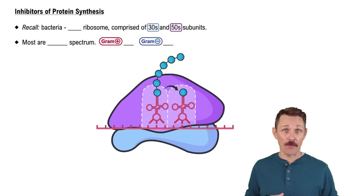
    Bacterial structure composed of 30S and 50S subunits, serving as the main target for many protein synthesis inhibitors.
  • 80S Ribosome

    Eukaryotic structure found in human cells, differing from bacterial counterparts and thus spared by certain antibiotics.
  • 30S Subunit

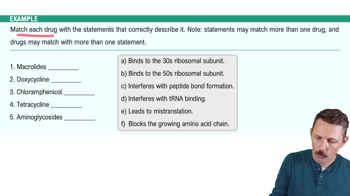
    Smaller component of the bacterial ribosome, targeted by tetracyclines and aminoglycosides to disrupt protein synthesis.
  • 50S Subunit

    Larger component of the bacterial ribosome, targeted by chloramphenicol and macrolides to inhibit protein assembly.
  • Tetracyclines

    Antibiotics that bind to the 30S subunit, preventing tRNA from attaching and thus halting protein formation.
  • Aminoglycosides

    Drugs that bind the 30S subunit, causing errors in protein translation and showing high efficacy against Gram-negative bacteria.
  • Chloramphenicol

    Agent that binds the 50S subunit, blocking peptide bond formation and potentially causing severe side effects.
  • Macrolides

    Antibiotics that attach to the 50S subunit, obstructing the exit of the growing polypeptide chain from the ribosome.
  • Peptide Bond Formation

    Process catalyzed by the ribosome to link amino acids, which is blocked by certain antibiotics to stop protein synthesis.
  • tRNA Binding

    Step in translation where transfer RNA attaches to the ribosome, a process hindered by tetracyclines.
  • Mistranslation

    Production of faulty proteins due to incorrect tRNA pairing, often induced by aminoglycosides.
  • Polypeptide Exit Tunnel

    Pathway in the ribosome for the emerging protein chain, which can be blocked by macrolides to halt protein synthesis.
  • Broad-Spectrum Antibiotics

    Drugs effective against a wide range of bacteria, including both Gram-positive and Gram-negative species.
  • Lipopolysaccharides

    Molecules on Gram-negative bacteria surfaces that attract aminoglycosides, enhancing drug uptake.