Back

Inhibitors of Nucleic Acid Synthesis quiz

Control buttons has been changed to "navigation" mode.
1/15
  • What is the main target of quinolone antibiotics in bacteria?

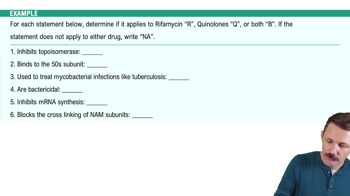
    Quinolones target bacterial topoisomerase enzymes, specifically DNA gyrase, which are essential for DNA replication.
  • How do quinolones cause bacterial cell death?

    They prevent topoisomerase from resealing DNA strands after cutting, leading to lethal double-strand breaks in bacterial DNA.
  • What modification distinguishes fluoroquinolones from quinolones?

    Fluoroquinolones are quinolones with a fluorine atom added, making them more effective and broad-spectrum.
  • What is a common clinical use for ciprofloxacin?

    Ciprofloxacin is often prescribed for urinary tract infections due to its broad-spectrum activity.
  • What rare but serious side effect is associated with fluoroquinolones?

    Fluoroquinolones can rarely cause tendon ruptures, which is a significant adverse effect.
  • Are fluoroquinolones effective against both gram-positive and gram-negative bacteria?

    Yes, fluoroquinolones are considered broad-spectrum antibiotics effective against both types.
  • What is the memory tool for remembering the target of quinolones?

    The phrase 'the queen is on top' helps recall that quinolones inhibit topoisomerase.
  • Which enzyme is inhibited by rifamycin antibiotics?

    Rifamycins inhibit RNA polymerase, blocking RNA synthesis in bacteria.
  • How does rifamycin affect RNA synthesis?

    It binds to RNA polymerase and prevents the linking of new RNA nucleotides, stopping RNA production.
  • What is a specific rifamycin drug used to treat tuberculosis and leprosy?

    Rifampin is a rifamycin used to treat tuberculosis and leprosy caused by mycobacteria.
  • Does rifampin have a broad or narrow spectrum of activity?

    Rifampin treats most gram-positive bacteria and some gram-negative bacteria.
  • What is the memory tool for remembering rifamycin’s mechanism?

    Remember 'rifamycin inhibits RNA polymerase' because both words start with 'R.'
  • Why are inhibitors of nucleic acid synthesis selectively toxic to bacteria?

    They target bacterial enzymes that differ from human enzymes, minimizing harm to human cells.
  • What process do quinolones and fluoroquinolones disrupt in bacteria?

    They disrupt DNA replication by inhibiting topoisomerase and DNA gyrase.
  • Why is understanding these inhibitors important for antibiotic resistance and treatment strategies?

    It helps in choosing effective drugs and understanding how bacteria might develop resistance to them.