Back

Immunotherapy: Monoclonal Antibodies quiz

Control buttons has been changed to "navigation" mode.
1/15
  • What does the term 'monoclonal' in monoclonal antibodies refer to?

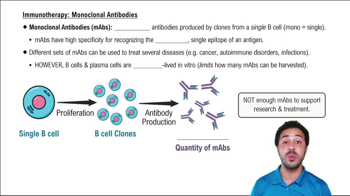
    'Monoclonal' means the antibodies are produced by clones derived from a single B cell, making them identical.
  • What is the main advantage of monoclonal antibodies (MABs) in targeting antigens?

    Monoclonal antibodies have high specificity for a single epitope, allowing them to bind to the same spot on an antigen.
  • Why are monoclonal antibodies useful in blocking or binding specific antigen positions?

    Because they all target the same epitope, they can effectively compete for and block that specific site.
  • Name three diseases that monoclonal antibodies can be used to treat.

    Monoclonal antibodies can be used to treat cancer, autoimmune disorders, and infections.
  • Why is the in vitro lifespan of B cells and plasma cells a problem for monoclonal antibody production?

    B cells and plasma cells are short-lived in vitro, limiting the quantity of monoclonal antibodies that can be harvested.
  • What technology is used to overcome the limited lifespan of B cells for monoclonal antibody production?

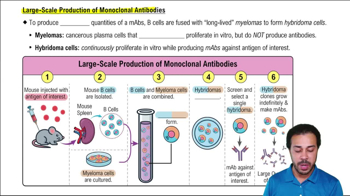
    Hybridoma technology is used, which involves fusing B cells with long-lived myeloma cells.
  • What are myeloma cells and why are they important in hybridoma technology?

    Myeloma cells are cancerous plasma cells that can proliferate indefinitely in vitro but do not produce antibodies.
  • What is a hybridoma cell?

    A hybridoma cell is formed by fusing a B cell with a myeloma cell, combining continuous proliferation with antibody production.
  • What is the first step in large-scale monoclonal antibody production?

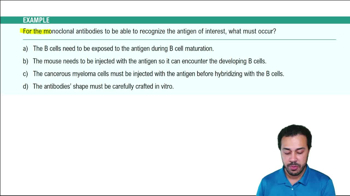
    The first step is injecting a mouse with the antigen of interest to stimulate its immune system.
  • After immunizing a mouse, what is isolated from its spleen for monoclonal antibody production?

    B cells are isolated from the mouse's spleen.
  • How are hybridoma cells created in the laboratory?

    Hybridoma cells are created by chemically inducing the fusion of B cells and myeloma cells in a test tube.
  • What is the purpose of culturing hybridoma cells on selective media?

    Selective media allows only hybridoma cells to grow, helping to isolate those producing the desired antibody.
  • Why must hybridoma cells be screened after fusion?

    Not all hybridomas will produce the antibody of interest, so screening is needed to select the correct one.
  • How does hybridoma technology enable large-scale monoclonal antibody production?

    Hybridoma cells can be grown continuously and indefinitely, producing large quantities of monoclonal antibodies.
  • What is the final outcome of the hybridoma process for monoclonal antibody production?

    A single hybridoma cell producing the desired monoclonal antibody is selected and cultured to generate enough antibodies for research and treatment.