Back

Immunotherapy: Monoclonal Antibodies definitions

Control buttons has been changed to "navigation" mode.
1/15
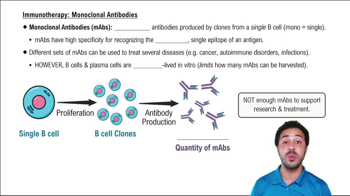
  • Monoclonal Antibody

    An identical immunoglobulin produced by a single B cell clone, binding a specific antigen epitope with high specificity.
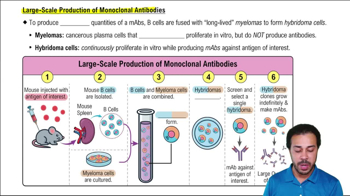
  • B Cell

    A lymphocyte capable of differentiating into plasma cells and producing antibodies after antigen stimulation.
  • Epitope

    A precise molecular region on an antigen recognized and bound by an antibody.
  • Antigen

    A molecule or molecular structure that triggers an immune response, often targeted by antibodies.
  • Plasma Cell

    A differentiated B lymphocyte specialized for rapid and abundant antibody secretion.
  • Hybridoma

    A fused cell combining a B cell and a myeloma, capable of indefinite proliferation and monoclonal antibody production.
  • Myeloma

    A cancerous plasma cell line with the ability to proliferate indefinitely but lacking antibody production.
  • Proliferation

    The process by which cells undergo repeated division, increasing their numbers.
  • Immunotherapy

    A treatment approach utilizing components of the immune system, such as antibodies, to combat diseases.
  • Selective Media

    A laboratory growth environment designed to support only specific cell types, such as hybridomas.
  • Screening

    A laboratory process for identifying cells producing a desired antibody among a mixed population.
  • Clone

    A group of genetically identical cells derived from a single progenitor, sharing the same antibody specificity.
  • In Vitro

    A process or reaction occurring outside a living organism, typically in a controlled laboratory setting.
  • Antibody Production

    The synthesis and secretion of immunoglobulins by plasma cells or hybridomas in response to antigen exposure.
  • Autoimmune Disorder

    A disease state where the immune system mistakenly targets and attacks the body's own tissues.