Back

Immunoassays Detecting Antigen-Antibody Aggregates quiz

Control buttons has been changed to "navigation" mode.
1/15
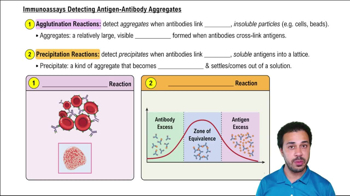
  • What is the main difference between agglutination and precipitation reactions in immunoassays?

    Agglutination involves antibodies cross-linking antigens on large insoluble particles, while precipitation involves antibodies cross-linking small soluble antigens to form insoluble lattices.
  • What type of particles are involved in agglutination reactions?

    Agglutination reactions involve large insoluble particles such as cells or artificial latex beads.
  • How are antigen-antibody aggregates detected in agglutination and precipitation reactions?

    They are detected visibly with the naked eye due to the formation of clumps or precipitates.
  • What is direct agglutination, and what is an example of its use?

    Direct agglutination uses antibodies to cross-link native antigens, such as hemagglutination for ABO blood typing.
  • How does indirect agglutination differ from direct agglutination?

    Indirect agglutination uses antibodies or antigens artificially attached to particles like latex beads, rather than their native forms.
  • What is the purpose of using latex beads in indirect agglutination reactions?

    Latex beads serve as carriers for antibodies or antigens, allowing detection of specific infections such as streptococci.
  • What does the presence of clumping in a hemagglutination test indicate?

    Clumping indicates the presence of specific antigens on red blood cells, helping to determine blood type.
  • What is a precipitate in the context of precipitation reactions?

    A precipitate is an insoluble lattice formed when antibodies cross-link small soluble antigens.
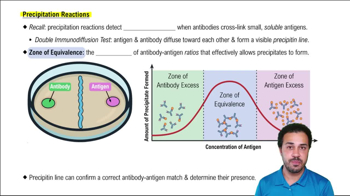
  • What is the double immunodiffusion test used for?

    It is used to detect specific antibody-antigen interactions by forming visible precipitin lines in a gel.
  • What is the 'zone of equivalence' in a double immunodiffusion test?

    The zone of equivalence is the range of antibody-antigen ratios where precipitin lines form, indicating a correct match.
  • Why might a precipitin line not form in a double immunodiffusion test?

    A precipitin line will not form if there are too many or too few antibodies or antigens, so the ratio is not optimal.
  • How can the double immunodiffusion test confirm the presence of antibodies in a patient sample?

    If a precipitin line forms, it confirms the patient has antibodies that bind to the tested antigen.
  • What is the significance of the lack of agglutination in a blood typing test?

    The lack of agglutination indicates the absence of the specific antigen being tested for on the red blood cells.
  • What is meant by 'passive agglutination'?

    Passive agglutination refers to indirect agglutination reactions where antibodies or antigens are artificially attached to particles like latex beads.
  • What does a visible precipitant line in a double immunodiffusion test indicate?

    It indicates a specific antibody-antigen interaction and confirms the presence of the correct antibody or antigen in the sample.