Back

Immunoassays Detecting Antigen-Antibody Aggregates definitions

Control buttons has been changed to "navigation" mode.
1/15
  • Agglutination

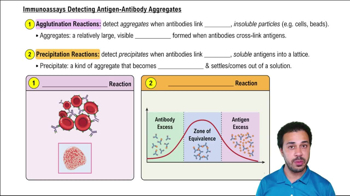
    Clumping of large insoluble particles due to antibodies cross-linking antigens, forming visible aggregates in solution.
  • Precipitation

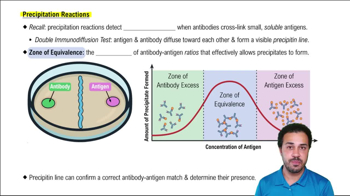
    Formation of insoluble lattices when antibodies cross-link small soluble antigens, resulting in visible precipitates.
  • Antigen

    Molecule capable of binding to antibodies, often found on cells or pathogens, and triggers immune detection.
  • Antibody

    Y-shaped protein produced by the immune system that specifically binds to antigens, facilitating their detection.
  • Direct Agglutination

    Reaction using native antigens, typically on whole cells, to detect clumping directly with specific antibodies.
  • Indirect Agglutination

    Test where antibodies or antigens are attached to latex beads, enabling detection of target molecules in samples.
  • Hemagglutination

    Type of direct agglutination used for blood typing by detecting antigens on red blood cells via visible clumping.
  • Latex Beads

    Artificial particles used as carriers for antibodies or antigens in indirect agglutination assays to enhance visibility.
  • Precipitant Line

    Visible line formed in a gel where optimal antigen-antibody ratios create insoluble precipitates, confirming specific binding.
  • Double Immunodiffusion

    Gel-based assay where antigen and antibody diffuse toward each other, forming a precipitant line at the zone of equivalence.
  • Zone of Equivalence

    Region where antigen and antibody concentrations are optimal for maximal precipitate formation in immunodiffusion tests.
  • Zone of Antibody Excess

    Area in immunodiffusion where surplus antibodies prevent precipitate formation due to unbalanced ratios.
  • Zone of Antigen Excess

    Area in immunodiffusion where surplus antigens inhibit precipitate formation by overwhelming available antibodies.
  • Adaptive Immunity

    Immune response involving specific recognition and memory of antigens, assessed by immunodiagnostic assays.
  • Immunodiagnostics

    Field utilizing antigen-antibody interactions to detect or quantify immune components for disease diagnosis.