Back

Immunoassay: Western Blotting quiz

Control buttons has been changed to "navigation" mode.
1/15
  • What is the main purpose of Western blotting in the laboratory?

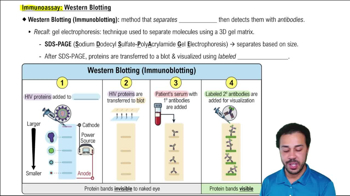
    Western blotting is used to separate proteins by size and detect specific proteins using labeled antibodies.
  • What does SDS-PAGE stand for in the context of Western blotting?

    SDS-PAGE stands for sodium dodecyl sulfate polyacrylamide gel electrophoresis.
  • How does SDS-PAGE separate proteins?

    SDS-PAGE separates proteins based strictly on their size, not their charge.
  • What is the purpose of transferring proteins to a blotting membrane in Western blotting?

    Transferring proteins to a blotting membrane allows for the detection of specific proteins using antibodies.
  • What is typically used as the blotting membrane in Western blotting?

    A protein-binding sheet, often described as a fancy, expensive sheet of paper, is used as the blotting membrane.
  • What is the role of the primary antibody in Western blotting?

    The primary antibody binds specifically to the target antigen (protein) on the blot.
  • How are the protein bands visualized in Western blotting?

    Protein bands are visualized by adding labeled secondary antibodies that bind to the primary antibodies, allowing detection.
  • Why are labeled secondary antibodies used in Western blotting?

    Labeled secondary antibodies enable visualization of the antigen-antibody complexes, often through fluorescence or other markers.
  • At what step do the protein bands become visible in Western blotting?

    Protein bands become visible after the addition of labeled secondary antibodies in the final step.
  • What is the significance of detecting protein bands in a Western blot for HIV diagnosis?

    Detection of protein bands indicates the presence of antibodies against HIV proteins, confirming HIV infection.
  • What is the function of the patient’s serum in the Western blot procedure?

    The patient's serum provides primary antibodies that may bind to the specific antigens (proteins) on the blot.
  • Why are the protein bands invisible during the initial steps of Western blotting?

    The protein bands are invisible because they have not yet been labeled with detectable markers.
  • How does Western blotting demonstrate antigen-antibody specificity?

    Only antibodies that specifically recognize the target antigen will bind, demonstrating antigen-antibody specificity.
  • What is the order of the main steps in Western blotting?

    The main steps are: protein separation by SDS-PAGE, transfer to a blot, incubation with primary antibody, and detection with labeled secondary antibody.
  • How does the size of a protein affect its movement through the SDS-PAGE gel?

    Larger proteins move more slowly and remain near the top, while smaller proteins move faster and migrate toward the bottom of the gel.