Back

Immunoassay: Western Blotting definitions

Control buttons has been changed to "navigation" mode.
1/15
  • Western Blotting

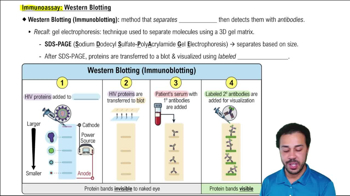
    A method combining protein separation by size and antibody-based detection to identify specific proteins in a sample.
  • Immunoblotting

    A technique using antibodies to detect specific proteins after their separation and transfer to a membrane.
  • SDS-PAGE

    A gel electrophoresis method using sodium dodecyl sulfate to separate proteins strictly by size.
  • Gel Electrophoresis

    A laboratory process that separates molecules, such as proteins, through a gel matrix based on physical properties.
  • Blotting Membrane

    A protein-binding sheet that receives separated proteins from a gel for subsequent antibody detection.
  • Primary Antibody

    An immunoglobulin from patient serum that specifically binds to target antigens on the blot.
  • Secondary Antibody

    A labeled immunoglobulin that binds to primary antibodies, enabling visualization of antigen-antibody complexes.
  • Antigen

    A molecule, often a protein, recognized by antibodies and used as a target in immunoassays.
  • Antibody

    A protein produced by the immune system that binds specifically to antigens for detection or defense.
  • Protein Band

    A visible marker on a blot indicating the presence of a specific protein after antibody detection.
  • Visualization

    The process of making protein bands detectable, often using labeled antibodies, after transfer to a membrane.
  • Serum

    The component of blood containing antibodies, used to detect immune responses in diagnostic assays.
  • Molecular Diagnostics

    A field utilizing techniques like Western blotting to detect specific proteins for disease diagnosis.
  • Antigen-Antibody Complex

    A structure formed when an antibody binds specifically to its target antigen, enabling detection.
  • Adaptive Immunity

    A branch of the immune system involving specific recognition of antigens and production of antibodies.