Back

Exotoxins vs. Endotoxin Review quiz

Control buttons has been changed to "navigation" mode.
1/15
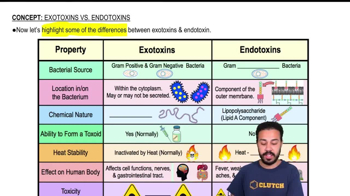
  • Which types of bacteria can produce exotoxins?

    Exotoxins can be produced by both gram-positive and gram-negative bacteria.
  • Where are exotoxins typically found within the bacterial cell?

    Exotoxins are found within the cytoplasm of the bacterial cell.
  • How can exotoxins be released into the environment?

    Exotoxins may be actively secreted or released upon cell lysis.
  • What is the bacterial source of endotoxins?

    Endotoxins are exclusively associated with gram-negative bacteria.
  • What is the chemical nature of exotoxins?

    Exotoxins are protein-based, consisting of chains of amino acids.
  • What is the chemical nature of endotoxins?

    Endotoxins are lipopolysaccharides (LPS) found in the outer membrane of gram-negative bacteria.
  • Which component of LPS is responsible for the toxicity of endotoxins?

    The lipid A component of LPS is the toxic portion of endotoxins.
  • Can exotoxins be converted into toxoids for vaccines?

    Yes, most exotoxins can be converted into toxoids for use in vaccines.
  • Can endotoxins be converted into toxoids?

    No, endotoxins cannot be converted into toxoids.
  • Are exotoxins heat-sensitive or heat-resistant?

    Exotoxins are heat-sensitive and can be inactivated by heat.
  • Are endotoxins heat-sensitive or heat-resistant?

    Endotoxins are heat-resistant and are not easily inactivated by heat.
  • What types of effects can exotoxins have on the human body?

    Exotoxins can affect cell functions, cause cell lysis, and impact specific tissues such as nerves or the gastrointestinal tract.
  • What is a major effect of endotoxins if they enter the bloodstream?

    Endotoxins can cause septic shock, fever, weakness, and potentially death if they enter the bloodstream.
  • How does the toxicity of exotoxins compare to endotoxins?

    Exotoxins generally have high toxicity, while endotoxins have low toxicity unless they enter the bloodstream.
  • How does the lethal dose of exotoxins compare to endotoxins?

    Exotoxins have a very low lethal dose, causing effects at small concentrations, whereas endotoxins require larger concentrations to be harmful.