Back

Exotoxins Cause Damage to the Host quiz

Control buttons has been changed to "navigation" mode.
1/15
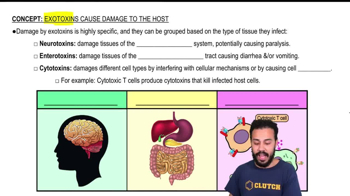
  • What are exotoxins and how are they categorized based on the tissue they damage?

    Exotoxins are highly specific toxins produced by microbes, categorized as neurotoxins (nervous system), enterotoxins (intestinal tract), and cytotoxins (cellular mechanisms or cell lysis).
  • What effect do neurotoxins have on the host?

    Neurotoxins damage the nervous system and can potentially cause paralysis.
  • What symptoms can enterotoxins cause in the host?

    Enterotoxins damage the intestinal tract, leading to symptoms such as diarrhea and vomiting.
  • How do cytotoxins affect host cells?

    Cytotoxins interfere with cellular mechanisms or cause cell lysis, killing infected host cells.
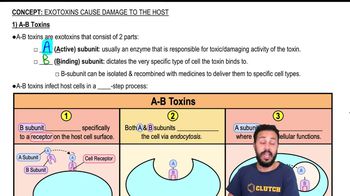
  • What are the two subunits of AB toxins and their functions?

    AB toxins consist of an 'A' (active) subunit, which is an enzyme responsible for toxic activity, and a 'B' (binding) subunit, which determines the specific cell type the toxin binds to.
  • Which subunit of AB toxins is responsible for the toxic damaging activity?

    The 'A' (active) subunit is responsible for the toxic damaging activity of AB toxins.
  • What is the role of the 'B' subunit in AB toxins?

    The 'B' (binding) subunit dictates the specific cell type the toxin binds to but is not necessarily toxic itself.
  • Describe the process by which AB toxins enter host cells.

    AB toxins bind to cell receptors via the 'B' subunit, enter the cell through endocytosis, and the 'A' subunit then disrupts cellular functions in the cytoplasm.
  • What cellular function can AB toxins inhibit once inside the host cell?

    AB toxins can inhibit translation, preventing mRNA from being converted into protein.
  • What are membrane damaging toxins and what is their main effect?

    Membrane damaging toxins are exotoxins that disrupt cytoplasmic membranes, causing cell lysis.
  • What are pore-forming toxins (PFTs) and how do they damage cells?

    Pore-forming toxins create holes in the phospholipid bilayer of host cells, leading to cell lysis.
  • How do phospholipases cause cell lysis?

    Phospholipases are enzymes that hydrolyze phospholipids in the membrane, disrupting it and causing cell lysis.
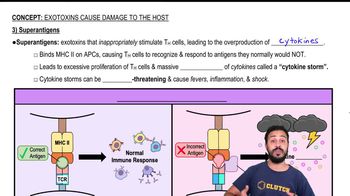
  • What are superantigens and how do they affect the immune system?

    Superantigens are exotoxins that inappropriately stimulate helper T cells, causing excessive cytokine production.
  • How do superantigens interact with MHC class II molecules?

    Superantigens bind to MHC class II molecules on antigen-presenting cells, causing helper T cells to respond to antigens they normally would not.
  • What is a cytokine storm and why is it dangerous?

    A cytokine storm is a massive release of cytokines caused by superantigens, which can be life-threatening and lead to fever, inflammation, and shock.