Back

Eukaryotic Cilia & Flagella quiz

Control buttons has been changed to "navigation" mode.
1/15
  • What cytoskeletal component forms the main structure of eukaryotic cilia and flagella?

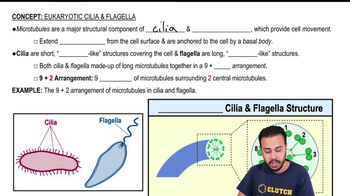
    Microtubules form the main structure of eukaryotic cilia and flagella.
  • What is the arrangement of microtubules in eukaryotic cilia and flagella called?

    It is called the 9+2 arrangement, with 9 pairs of microtubules surrounding 2 central microtubules.
  • How are cilia and flagella anchored to the cell?

    They are anchored to the cell by a basal body.
  • Describe the physical appearance of cilia compared to flagella.

    Cilia are short, hair-like structures covering the cell, while flagella are longer, tail-like structures.
  • What type of movement is associated with cilia?

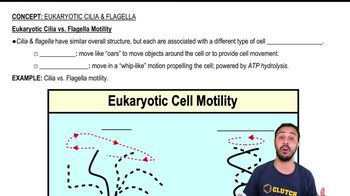
    Cilia move in a manner similar to oars, moving objects around the cell or propelling the cell itself.
  • How do flagella move to propel the cell?

    Flagella move in a whip-like fashion to propel the cell through its environment.
  • What energy source powers the movement of eukaryotic flagella?

    Eukaryotic flagella are powered by ATP hydrolysis.
  • How does the energy source for prokaryotic flagella differ from that of eukaryotic flagella?

    Prokaryotic flagella are powered by a proton motive force (PMF), not ATP hydrolysis.
  • What is the main function of cilia and flagella in eukaryotic cells?

    Their main function is to provide cell movement.
  • Where do cilia and flagella extend from on the cell?

    They extend outward from the cell surface.
  • What does the '9+2' arrangement refer to in cilia and flagella?

    It refers to 9 pairs of microtubules surrounding 2 central microtubules.
  • What is the difference in movement between cilia and flagella?

    Cilia move like oars, while flagella move in a whip-like fashion.
  • What is the role of ATP in the function of eukaryotic flagella?

    ATP provides the energy needed for the whip-like movement of eukaryotic flagella.
  • Can cilia move both the cell and objects around the cell?

    Yes, cilia can move the cell itself or move objects around the cell.
  • What structural feature is shared by both cilia and flagella?

    Both have a 9+2 arrangement of microtubules and are anchored by a basal body.