Back

Eukaryotic Cilia & Flagella definitions

Control buttons has been changed to "navigation" mode.
1/14
  • Cilia

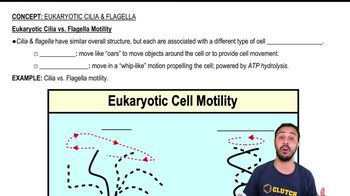
    Short, hair-like projections covering the cell surface, moving objects or the cell itself with oar-like strokes.
  • Flagella

    Long, tail-like extensions that propel cells through their environment using whip-like movements.
  • Microtubules

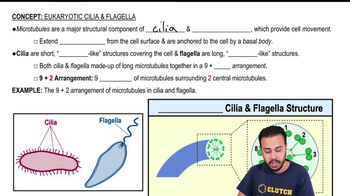
    Cylindrical protein structures forming the internal scaffold of cilia and flagella, arranged in a specific pattern.
  • Cytoskeleton

    Cellular framework providing structure and support, with microtubules as a key component in movement organelles.
  • Basal Body

    Anchoring structure at the cell surface from which cilia and flagella extend outward.
  • 9+2 Arrangement

    Pattern of nine microtubule pairs surrounding two central microtubules, characteristic of eukaryotic cilia and flagella.
  • Motility

    Capacity for movement, especially as seen in cilia and flagella enabling cells to move or shift materials.
  • ATP Hydrolysis

    Energy-releasing process that powers the movement of eukaryotic flagella and cilia.
  • Oar-like Motion

    Movement pattern of cilia, resembling the back-and-forth action of boat oars.
  • Whip-like Motion

    Movement pattern of flagella, generating propulsion through rapid, undulating waves.
  • Proton Motive Force

    Energy source for prokaryotic flagella, distinct from the ATP-driven movement in eukaryotes.
  • Cell Surface

    Outer boundary of the cell from which cilia and flagella project.
  • Central Microtubules

    Pair of microtubules located at the core of the 9+2 arrangement in cilia and flagella.
  • Peripheral Microtubule Pairs

    Nine pairs of microtubules forming the outer ring in the 9+2 arrangement.