Back

Drug Interactions: Synergism and Antagonism quiz

Control buttons has been changed to "navigation" mode.
1/15
  • What is drug synergism in the context of antibiotics?

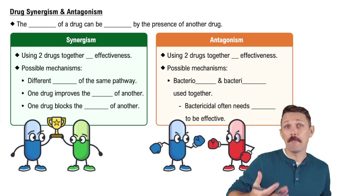
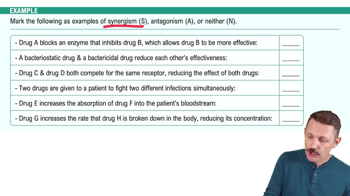
    Drug synergism occurs when two antibiotics used together increase each other's effectiveness beyond what would be expected from their individual effects.
  • What is drug antagonism in antibiotic therapy?

    Drug antagonism happens when the combined effect of two antibiotics is less effective than when used separately, meaning one drug reduces the efficacy of the other.
  • How can targeting different steps in the same biochemical pathway lead to synergism?

    Using two drugs that target different steps in the same pathway can more effectively shut down that pathway, enhancing the overall antibacterial effect.
  • How does one drug improving the uptake of another contribute to synergism?

    If one drug disrupts the bacterial cell wall or membrane, it can make it easier for another drug to enter the cell, increasing the second drug's effectiveness.
  • What is an example of a drug blocking the inhibitor of another drug?

    If one drug inhibits a molecule that would otherwise block another drug, the second drug can work more effectively, demonstrating synergism.
  • Why is understanding drug interactions important in antibiotic therapy?

    Understanding these interactions helps optimize treatment, combat antibiotic resistance, and ensure effective bacterial infection management.
  • What does a bacteriostatic drug do?

    A bacteriostatic drug pauses or inhibits bacterial cell growth without directly killing the cells.
  • What does a bactericidal drug do?

    A bactericidal drug kills bacteria, often by targeting processes that occur during cell growth.
  • Why can combining a bacteriostatic and a bactericidal drug lead to antagonism?

    Because bactericidal drugs often require actively growing cells to be effective, and bacteriostatic drugs halt growth, reducing the bactericidal drug's effectiveness.
  • Is synergism or antagonism more common in antibiotic combinations?

    Synergism is more commonly observed in antibiotic combinations than antagonism.
  • What is meant by the efficacy of a drug?

    Efficacy refers to how well a drug achieves its intended effect, such as killing or inhibiting bacteria.
  • How can using two drugs together reduce the amount of each drug needed?

    If the drugs act synergistically, they can achieve the desired effect at lower doses than if used alone.
  • What is the role of cell wall disruption in drug synergism?

    Disrupting the cell wall can enhance the entry of other antibiotics into the bacterial cell, increasing their effectiveness.
  • What does the term 'antagonistic' mean in the context of drug interactions?

    It means that the drugs interfere with each other's actions, resulting in decreased overall effectiveness.
  • Why should clinicians be cautious when combining antibiotics?

    Because certain combinations can lead to antagonism, reducing treatment effectiveness and potentially contributing to resistance.