Back

DNA Repair Mechanisms quiz

Control buttons has been changed to "navigation" mode.
1/15
  • What is the main function of DNA polymerase proofreading during DNA replication?

    DNA polymerase proofreading identifies and corrects mismatches by removing incorrect nucleotides using its 3' to 5' exonuclease activity and replacing them with the correct ones.
  • How does DNA polymerase recognize and correct a mismatched nucleotide?

    It backtracks in the 3' to 5' direction, removes the incorrect nucleotide, and then adds the correct one to continue replication.
  • What happens if DNA polymerase proofreading fails to correct a mismatch?

    The cell uses mismatch repair, which removes and resynthesizes the region of DNA containing the mismatch.
  • How does the mismatch repair system distinguish between the old and new DNA strands?

    It uses methylation; the old template strand is methylated, while the newly synthesized strand is not yet methylated.
  • What are the main steps of mismatch repair?

    An enzyme cuts the new DNA strand near the mismatch, removes a short stretch containing the mismatch, DNA polymerase resynthesizes the correct sequence, and DNA ligase seals the fragment.
  • What type of DNA damage does base excision repair target?

    Base excision repair targets damaged nitrogenous bases that have been chemically modified.
  • Which enzyme is responsible for recognizing and removing damaged bases in base excision repair?

    DNA glycosylase identifies and removes the damaged nitrogenous base.
  • What happens after the damaged base is removed in base excision repair?

    An enzyme cuts the DNA backbone, DNA polymerase replaces the damaged region, and DNA ligase seals the DNA.
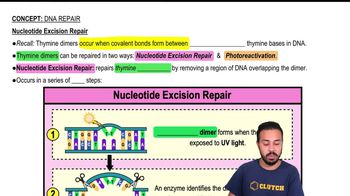
  • What type of DNA damage does nucleotide excision repair primarily fix?

    Nucleotide excision repair primarily fixes larger DNA distortions such as thymine dimers caused by UV light.
  • How does nucleotide excision repair remove thymine dimers?

    It removes a segment of DNA containing the dimer, then DNA polymerase synthesizes a new fragment and DNA ligase seals it.
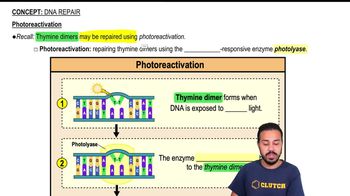
  • What is photoreactivation and which enzyme does it use?

    Photoreactivation is a repair mechanism for thymine dimers that uses the enzyme photolyase to break the covalent bonds under light exposure.
  • How does photolyase repair thymine dimers?

    Photolyase binds to the dimer and, when exposed to light, breaks the covalent cross-link, restoring normal DNA structure.
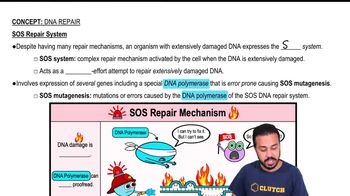
  • When is the SOS repair system activated in a cell?

    The SOS repair system is activated when there is extensive DNA damage that cannot be repaired by other mechanisms.
  • Why is the DNA polymerase used in the SOS repair system considered error-prone?

    It lacks proofreading activity, so it can introduce mutations during repair, a process known as SOS mutagenesis.
  • What is the main advantage and disadvantage of the SOS repair system?

    The advantage is that it repairs most of the DNA damage in emergencies, but the disadvantage is that it can introduce mutations.