Skip to main content
Microbiology
My Course
Learn
Exam Prep
AI Tutor
Study Guides
Textbook Solutions
Flashcards
Explore
Try the app
My Course
Learn
Exam Prep
AI Tutor
Study Guides
Textbook Solutions
Flashcards
Explore
Try the app
Back
DNA Repair Mechanisms definitions
You can tap to flip the card.
DNA Polymerase
You can tap to flip the card.
👆
DNA Polymerase
An enzyme responsible for building new DNA strands and correcting errors during replication through proofreading.
Track progress
Control buttons has been changed to "navigation" mode.
1/14
Related flashcards
Related practice
Recommended videos
DNA Repair Mechanisms quiz
DNA Repair Mechanisms
15 Terms
DNA Repair Mechanisms
16. Microbial Genetics
5 problems
Topic
Nicole
Horizontal Gene Transfer
16. Microbial Genetics
5 problems
Topic
Brendan
16. Microbial Genetics - Part 1 of 2
9 topics
14 problems
Chapter
Monica
16. Microbial Genetics - Part 2 of 2
8 topics
13 problems
Chapter
Nicole
Guided course
03:31
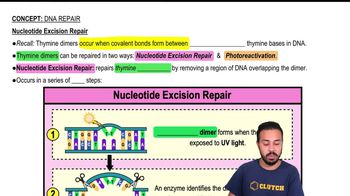
Nucleotide Excision Repair
1
views
Guided course
03:50
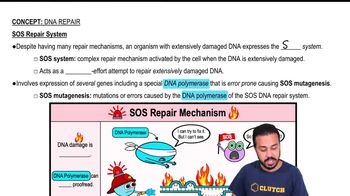
SOS Repair System
1
views
Guided course
02:29
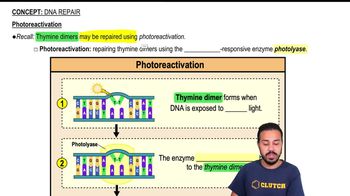
Photoreactivation
1
views
Terms in this set (14)
Hide definitions
DNA Polymerase
An enzyme responsible for building new DNA strands and correcting errors during replication through proofreading.
Proofreading
A self-correcting process where errors in newly synthesized DNA are detected and removed by a backward exonuclease activity.
Mismatch Repair
A mechanism that removes and resynthesizes DNA segments containing mismatched nucleotides missed by proofreading.
Methylation
A chemical modification marking the template DNA strand, allowing repair enzymes to distinguish old from new DNA.
Exonuclease Activity
The removal of nucleotides from the end of a DNA strand, enabling correction of replication errors.
Base Excision Repair
A pathway that removes chemically damaged nitrogenous bases and replaces them with correct ones using glycosylases.
Glycosylase
An enzyme that recognizes and excises damaged nitrogenous bases, initiating base excision repair.
Nucleotide Excision Repair
A process that removes bulky DNA lesions, such as thymine dimers, by excising a DNA segment and resynthesizing it.
Thymine Dimer
A covalent linkage between adjacent thymine bases, often caused by UV light, that distorts DNA structure.
Photoreactivation
A light-dependent repair mechanism where photolyase breaks covalent bonds in thymine dimers, restoring normal DNA.
Photolyase
A light-activated enzyme that binds to thymine dimers and cleaves their covalent bonds during photoreactivation.
SOS Repair System
A last-resort, error-prone DNA repair pathway activated by extensive DNA damage, involving multiple genes and enzymes.
SOS Mutagenesis
The introduction of mutations during the SOS repair process due to the error-prone DNA polymerase lacking proofreading.
DNA Ligase
An enzyme that seals nicks in the DNA backbone, joining newly synthesized fragments after repair.
 BackBack
 03:31
03:31